|
|
|
|
Tool Review: Gyokucho Rip Dozuki Saw
By Jeff Fleisher
|
|
|
Click on any picture to see a larger version.
The
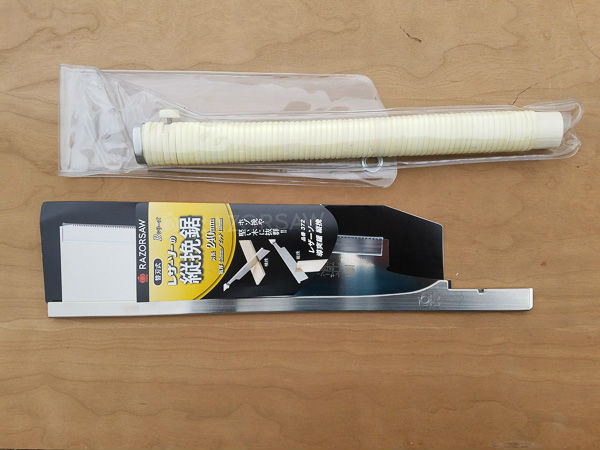
Gyokucho Rip Dozuki Saw, Model 372
is a Japanese saw used for high quality joinery. It
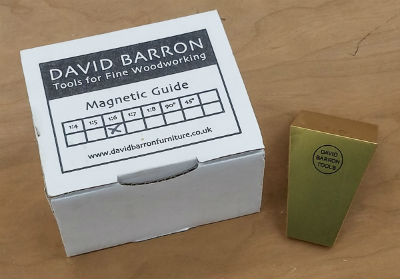
is the saw recommended by David Barron for use with his
Magnetic Dovetail Saw Guide
that I reviewed
in the
July 2016 issue of Wood News Online
. I have used Japanese saws in my shop but I typically use western version saws so I was
pleased to be able to use this particular saw for this review.
Woodworkers immediately think about two things when Japanese saws are mentioned. First, the
extremely thin blade which produces a very thin kerf. Second, the fact that you cut on the pull stroke
rather than the push stroke. They are obviously related. You use a Japanese saw on the pull stroke
because of the very thin blade. Pulling the blade through the wood keeps it under tension so it doesn't
bend. If used on the push stoke, like a western saw, the blade would twist and bend and potentially
break.
I have never understood the fascination of an extremely thin kerf since I have always figured
that the kerf is on the waste side of the line you are cutting to so the size of the kerf would not matter.
In most cases this is true but the one exception, and the one we will explore later in this review, is to
make a dovetail joint with an extremely narrow pin, something I've always wanted to try. This is a very beautiful joint and can only be done with a saw like this Dozuki saw.
The thin blade of the saw has impulse hardened teeth for long life and
smooth cutting. You'll get a very thin kerf and a glass-like smooth cut even in very hard woods. The
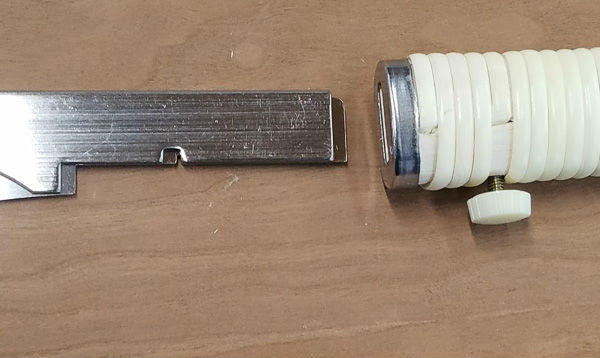
saw has a traditional wooden handle with a rattan cane wrapping and the blade is removable for both
easy storage and traveling and replacement if necessary. The teeth are cut at 19 teeth per inch and the
blade length is 9-7/16". The overall length of the saw is 23-7/8". The blade thickness is
approximately 1/16” with a kerf of 0.018”. The blade height (depth of cut) tapers along the length of the blade; at the heel the depth is 1-3/4” and at the toe it is 2-1/4”. There is a metal spine across the top
of the blade to keep it stiff and straight. Finally, the saw weighs in at 8-1/4oz.
It is extremely easy to install/remove the blade.
Replacement blades
are available for purchase.
I have read that it is extremely hard to self sharpen a Japanese blade because of the hardness of the steel
and shape of the teeth. Therefore, most people will just purchase a replacement blade.
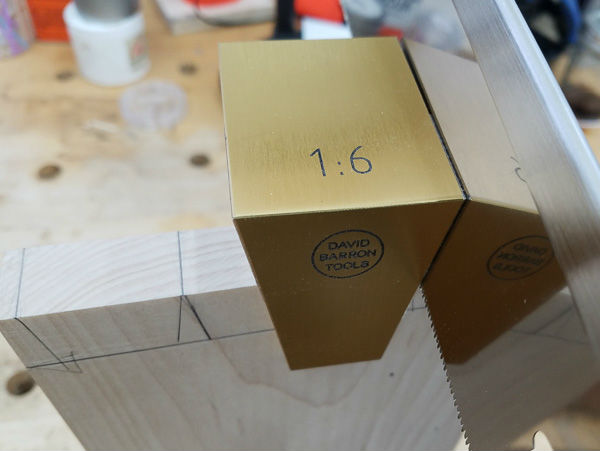
For this review, I am going to use the David Barron Magnetic Doveail Guide to help me cut the tail board for a dovetail joint with the saw (as recommended by David Barron, himself).
The jig comes in a variety of ratios for different shaped dovetail joints. David likes to use this saw with his jig because the thin blade
makes nice contact with the side of the dovetail jig and provides very little friction as it cuts into the
wood. You can actually feel the blade snap into place against the magnet embedded in the side of the
jig.
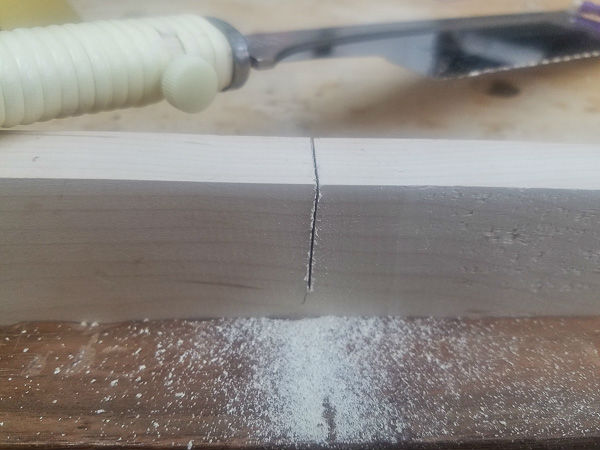
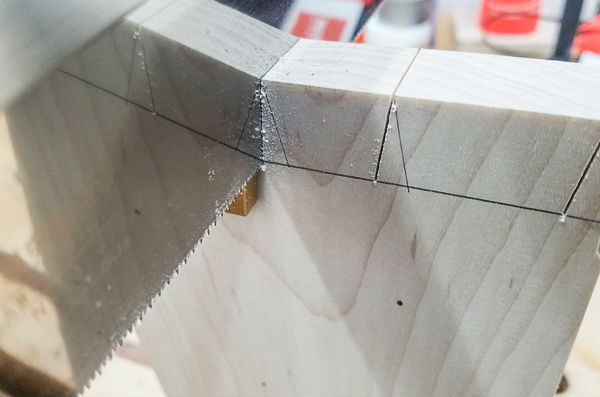
You can see in this picture that the saw creates a nice and clean cut with a narrow kerf. The saw
is designed as a rip saw but it does a very nice job with this cross-cut as well.
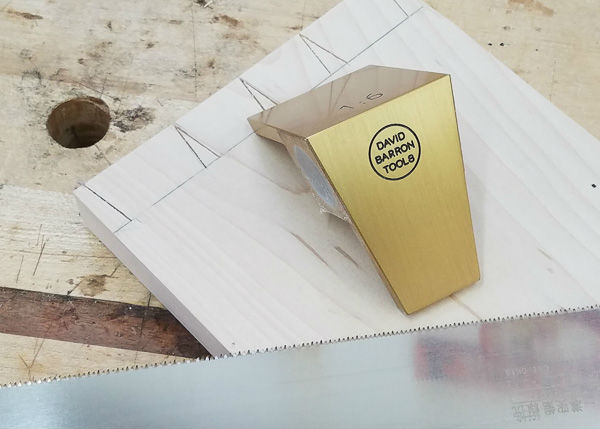
Time to make some very decorative dovetail cuts. I laid out a series of dovetails on a
piece of maple and was ready to give the saw a try. My goal was to make the point of the dovetail a
single blade thickness so I drew a single line across the end-grain and then used the jig to draw lines
down the face of the board to create my tail-board design.
With the saw against the side of the jig, I made my cuts. I found that the 19tpi spacing of the teeth
made it very easy to start the saw cut. The saw also tracked very nicely though the cut. I made cuts
using both the jig and then freehand and the saw tracked the line in each case. With the blade cutting
on the pull stroke, there was no bending or twisting. I felt like I had a lot of control over the saw. The
only issue I had was with the depth of cut available with the saw blade. The spine of the saw did hit the
dovetail jig as I neared the baseline of the dovetail at the heel of the saw. There was enough clearance
if I moved up to the toe of the blade. Obviously, this was not an issue when making some free-hand
cuts without the jig.
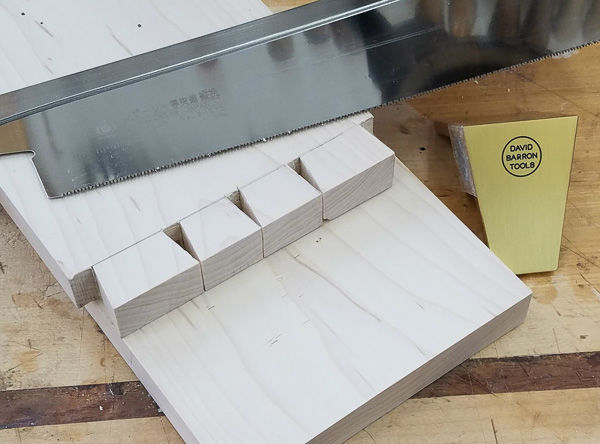
Here is a view of the board with all the cuts made and ready for removing the waste.
The next step is to chop out the waste with a chisel and mallet and I used a
Shenandoah Tool Works Mallet
with a 1/8” chisel. That process was not germane to the review so I will just show the
result after removing all the waste.
I really like how the pin openings in the tailboard look when using the dozuki saw. The pin
openings have a nicely defined shape and the thinness of the blade allows the pin to come almost to a
point. This shaped pin looks very decorative or artistic and really doesn't sacrifice much in terms of
holding strength. The saw felt very comfortable to use and I liked how easy it was to start a cut. It did
not take long to get accustomed to cutting on the pull stroke as compared to what I am used to with a
western saw. This saw can be used wherever you need to make a fine, delicate cut so I would
recommended having one in your shop.
Now....off to cut the pin board!
Click here to find out more and purchase your own
Gyokucho Rip Dozuki Saw
from Highland Woodworking.
Jeffrey Fleisher has been a woodworker for approximately 20 years and a professional woodworker for the past 6 years. He is the president of his local woodturning club, the Woodturners of the Virginias and past president of the Northern Virginia Carvers. You can see some of the furniture he has made at
www.jeffswooddesigns.com
. He can be reached by email at
furnmkr@gmail.com
Return to the
Wood News Online
front page
|
|
|
|
|