|
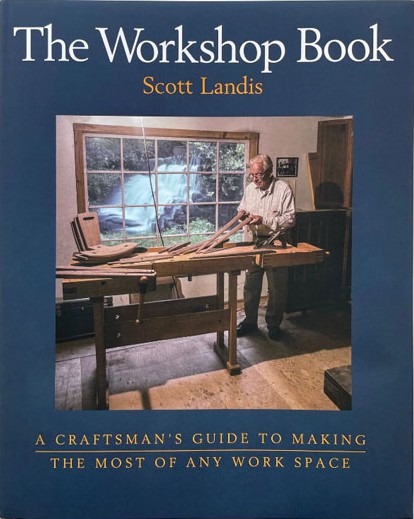
Scott Landis, the author of
The Workbench Book
I recently reviewed, has written a
parallel volume on workshops titled
The Workshop Book
. Like his book on workbenches, this book reports on the
results of a broad survey of workshops throughout North America. The result: a
comprehensive review of workshops in practice, their design and features, that will be a
valuable source of information and guidance for any woodworker setting out to build a
new workshop or refashion or upgrade an existing one. Like
The Workbench Book
, this
book reports on site visits to a wide range of workshops and details the ways in which
their design and equipping suits the type of woodworking each conducts. In
consequence, Landis is able to convey practical experience as opposed to theoretical
principles to inform woodworkers' choices in the design of their own shops.
The first decision a woodworker encounters in planning a workshop is where it should
be located. The most common location for home woodworkers is the basement. This
choice has the advantage of being close at hand and using other potentially vacant
space. But it comes with some downsides, including the likelihood of concrete walls
and a lack of natural light. Garage workshops, also popular, have similar benefits to
basement workshops but face the probability of lack of water, limited electric power, and
poorer heat and humidity control.
Landis reviews other configurations as alternatives that will be options some
woodworkers can consider. These include devoting a room in the home to
woodworking, using the whole house or one floor, a freestanding building, repurposing
an industrial building, and setting up a storefront workshop. Each of these options has
its benefits and downsides, which are laid bare in Landis's conversations with the
owners of these types of shop.
Once the location has been decided, the next set of decisions concern the shop's
layout. Landis underscores a key principle to observe in laying out any shop: to
maintain as much flexibility as possible to allow for future adjustments and changes,
both temporary and permanent.
Among the arrangements Landis observed and documented are Kelly Mehler's division
of his workspace into zones for different kinds of operation, an organization Landis
terms "triangle" grouping in which complementary tools and fixtures are co-located.
Another arrangement is to set up dedicated spaces for specific functions — spray booths,
offices, showrooms, and sharpening stations are examples. Some shops are shared
with multiple woodworkers; these may combine common spaces for shared equipment
with individual workspaces for each woodworker.
Landis describes other scenarios that may work for woodworkers with greater space
restrictions. A minimalist shop might have fewer machines or be a hand tool focused
shop to save space. Other shops — like this writer's — might be what Landis calls
"eclectic," combining several functions such as photography, metalworking, ceramics,
and other parallel creative activities. He also shows some woodshops that are set up in
cars and other vehicles.
Equipping the shop is the next consideration. The issue here, he says, is not what
machinery you own but how it fits into your woodworking practice. His advice: start with
the machines that will do the most grunt work. And he repeats Tage Frid's caution not
to buy cheap or underpowered tools. Landis offers some advice of his own about table
saw selection, though it should be noted that he wrote before the
SawStop
went into
production.
Although most woodworkers will choose to purchase their tools new or used, some
have made a practice of rebuilding older equipment and in some cases making it
themselves in the shop. As you tour workshops with Landis, you'll meet several
woodworkers who've made good use of this tactic and get the benefit of their
experience.
Other possibilities are human-powered shops in which such tools as lathes, drills,
jointers, and shapers, among others, are pedal powered. And, as a foretaste of what
was to become, Landis points to computer-driven workshops, though his observations
were penned in a pre-CNC and laser engraving day and thus lack the latest
developments in this area.
Encompassing other issues in setting up a workshop are what Landis terms "systems."
Often neglected in favor of tool selection, these are critically important backgrounds for
effective shop work. Systems, as he describes them, include structural elements such
as insulation, doors, floors, and walls; electricity; dust collection; lighting; heat and
humidity control; compressed air; fire and shop security; and plumbing. As he does
throughout the book, Landis delves into each element with a critical assessment of the
issues and options as informed by the experiences of those he interviewed.
In a chapter devoted to specialty workshops, Landis notes that shops work best when
they are designed to fit the functions of the work performed in them. He observes
several such shops, including two chairmaking shops that employ just the tools needed
to get their work done. Other cases he encounters are farm workshops, rolling
workshops such as a pickup truck and a van, and workshops set up for use by kids.
No shop will ever be perfect, of course, but Landis encounters some he regards as
dream workshops, and he portrays them in plenty of detail to inspire other woodworkers
to plan their own workshops for the future.
Storage is a problem in always-too-small shops. Tools, hardware, and wood all need to
have a convenient home in a shop. Landis shows several tool chests and toolboxes, for
which he includes plans that can be replicated. In addition, he surveys methods for
hanging tools on the walls and various means for storing lumber.
The final chapter addresses shop fixtures, which can help shops to function efficiently
and safely. Among the fixtures he reviews are sharpening stations, benches, horses,
auxiliary machine tables, workstations for portable tools, and safety accessories. He
provides plans for several fixtures, including a basic workbench, a veneer press, a
router table, and table saw sleds.
This book's primary value is the opportunity it offers to survey a wide range of workshop
solutions through the eyes of woodworkers who have adopted them. A study of this
wealth of information is guaranteed to better inform the choices a woodworker will make
in setting up his or her own shop. There is no right answer to shop design and each
implementation will be unique. The experiences in this book will help woodworkers to
find a best fit for their own work and help ensure that shop time is effective and safe.
This book has one other historical benefit. Landis points to the nearly complete lack of
information about how woodworking was organized and conducted in times past. He
cites what little we know. This volume fills the contemporary void by describing the
diversity of woodworking practices in the late 20th and early 21st centuries. As such, it
will have historical value well into the future.
Because it was originally published in 1991, it is out of date concerning some recent
developments, such as LED lighting, CNC machines, and finger saving features in tools.
But these omissions are slight in view of the overwhelming timeliness of the design,
organization, and equipping issues all woodworkers must confront in setting up shop.
The result is a volume of high and continuing relevance.
Hardbound and slip covered, this book is filled with photos and illustrations that make
Landis's descriptions come to life. Like all Lost Art Press books, it is a quality
production that will last a long time even under heavy and repeated consultation.
This is an excellent resource for any woodworker setting out to create a new shop,
whether for the first time or as an upgrade. It's an encyclopedic source of ideas drawn
from the practical experience of those who've tried each alternative. And it's a fun
opportunity to step inside a wide range of shops and look over the shoulders of other
woodworkers as they go about their business. For these reasons, it will make a
valuable addition to many woodworking libraries.
Find out more and purchase
The Workshop Book
at Highland Woodworking
J. Norman Reid is a woodworker, writer, photographer and woodworking instructor living in Virginia's Blue Ridge Mountains with his wife, a woodshop full of power and hand tools and two cats who think they are cabinetmaker's assistants. He is the author of
Choosing and Using Handplanes: All You Need to Know to Get Started Planing by Hand,
and co-owner of Shenandoah Tool Works. He can be reached by email at
jnreid45@gmail.com
.
Return to Wood News Online
|