|
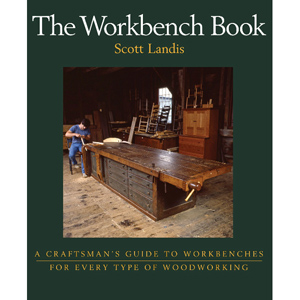
The Workbench Book
, a survey of many
workbench types
as designed and used by their builders, is
a classic in woodworking literature. Published originally in 1987, it has been freshly re-released by the
Lost Art Press
in a fine new edition. The book is the result of a massive
amount of research by Landis into the many individualized designs of workbenches as
they've been adapted by their builders to their particular specialties and ways of
working. That research is what makes this book unique. The result is a comprehensive
survey of both workbench designs and workholding methods, and it gives the reader an
encyclopedic view of the possibilities for creating a workspace tailored to one's own
requirements.
This is no dry compilation of facts and plans, however. The book is organized around
major styles of workbenches and illustrated by visits and conversations with builders
who've adopted each style and its variants. In each case, Landis skillfully explores the
reasoning behind their design choices and how those choices were influenced by the
type of work they do. The result is a clear picture of how each bench works for its
builder. His approachable and personalized treatment brings a human face to text that
might otherwise be unduly technical. The result is a refreshingly educational tour of the
builders' design experiences that enables any aspiring bench builder to work through
the many considerations and, in the end, create a bench that fits their needs.
To put things in broader perspective, Landis opens with two chapters that set the stage
for the meat of the volume. The first is a brief review of the history of workbenches,
which involved initially replacing the body as a workholding device and reducing the
amount of risk. Roman workbenches came first and lasted in similar form until the
Renaissance period, when newer forms began to evolve and alternative workholding
fixtures emerged.
This is succeeded by a chapter on the
Roubo workbench
in the 18th century. The Roubo
bench is simpler than most modern benches and lacks many of the workholding fixtures
of later designs. Landis visited one woodworker who built and uses a Roubo bench and
explores with him its construction and use in practice.
Modern bench designs follow.
Shaker benches
are the first examined. The simplicity of
Shaker benches follows the tenets of the sect's faith: built to be plain and without
superficiality. For the Shakers, form followed function. Still, simple did not imply
simplistic, and Shaker benches were both pleasingly designed and technologically up to
date. Shaker benches are often quite long, some extending to 12 feet in length. As he
does in each of his chapters, Landis visits with woodworkers who adopted the Shaker
style and explores the variations in design they employed and how they use their
benches to fit their woodworking styles.
Frank Klausz built a bench similar to the one he apprenticed on in his father's workshop
in his native Hungary. At 33 inches his bench is lower than most and requires him to
stand his work on end for dovetailing. The top of his bench is in two sections joined by
pins. Dog holes line the front of the bench; a tool tray is at the rear. Klausz takes special
pains to protect his benchtop, cleaning it daily to remove any spilled glue and renewing
it every few months to keep it well smoothed, oiled, and waxed.
Michael Fortune's bench is described as a modern hybrid. Fortune attended design
school in Toronto and then apprenticed in Sweden and England, experiences that
informed his workbench design preferences. In the months he spent with Alan Peters,
he learned that high-tech equipment is not necessary for good work. He first built a
bench that drew on Peters's design, then after a decade of use built newer benches for
Sheridan College, where he taught. After this evolution, another followed in which he
and author Landis designed a custom bench built at 39 inches, a height less amenable
to planing but easier on the back after a long day at work. An innovation was the use of
hinged spacer blocks that permitted the bench to be raised or lowered for different uses.
Fortune and Landis explored solutions to steadying their benches on uneven floors,
something with which all woodworkers must contend.
Ian Kirby's bench is basic. His message is that a bench must fit the way you intend to
work and the kinds of tools you use. Kirby's bench is simple, a laminated top without
end caps or battens. It's wider and shorter than most benches and uses bench stops
against which to plane. Kirby uses a variety of devices for workholding in lieu of vises: a
panel stop, a bench hook, and shooting boards. Landis describes how the bench was
built and how Kirby uses it in his work.
Another chapter samples various workbench styles and tackles the issues an aspiring
bench builder will need to negotiate. Should the bench have a tool tray or not? Should it
rest on a sled foot or four legs? How should it be joined? What accessories should it
employ?
While most woodworkers opt to build their own benches to suit their individual needs,
commercial benches are available as an alternative. The ease of deploying a ready-made bench is offset by their expense and the fact that some have been more poorly
made than a woodworker can do for him or herself. In the end, most woodworkers elect to create their own.
Workholding is, of course, a principal purpose of a bench, aided by various devices.
Landis considers both shop-built and off-the-shelf vises, a review that will leave the
reader well informed about the pluses and minuses of the many options.
Japanese beams and trestles represent a different approach. Landis spends time with
Toshio Odate, whose use of a simple heavy angled beam supported by a basic
sawhorse serves as a planing platform. Other simple devices serve to hold smaller
work.
Country shaves and brakes are yet another group of workholding devices suited for
green woodworking and country woodcraft. Landis interviews Drew Langsner, whose
work is more fully described in
Country Woodcraft: Then and Now
. His devices include
a shaving horse and various kinds of brakes to hold raw logs.
Boatbuilding has different workholding requirements from cabinetmaking. Here, most of
the work is done directly on the emerging boat. Much work on a boat is curved, not flat,
and its fit is judged by eye. A conventional bench is of little help in this instance. Much
experience is drawn from Norwegian boatbuilders, whose planing benches favored the
hewing axe. Typical boatbuilder benches are long and narrow, designed for shaping
keels and other extended components.
Yet another specialty is lutherie and its requirements for different workholding methods.
Since much of the work is done standing, benches need to be taller. Benches use a
variety of specialized workholding devices. Landis relates Richard Schneider's
experiences, details his bench, and describes how it was built.
Carvers need both security and accessibility in their benches. For sculpting, heavier,
movable workholding devices that can be elevated and rotated are useful. For smaller
work, sit down benches work well.
Finally, Landis comes to the venerable Workmate and describes its invention, design,
evolution, and the life of inventor Ron Hickman. It's an interesting conclusion to a
fascinating tour of all things workbench.
A significant appendix gives the plans and dimensions of a Shaker bench, Frank
Klausz's bench, Ian Kirby's bench, and the Fortune and Nelson bench.
Like all
Lost Art Press releases
, this book is well produced. Hard covered and perfect
bound, it features a slipcover, solid color and black-and-white photography and
illustrations throughout. This book is unquestionably a classic and will have broad appeal. Those woodworkers who are looking for ideas and options for a new or
replacement bench will find the mental exercises Landis introduces to be a valuable
alternative to mistakes in design and implementation. It is likewise a substantial
resource on alternative workholding devices, both incorporated in the bench design or
as independent appliances. For those who simply enjoy seeing how other woodworkers
do their work and want an overview of contemporary woodworking practice, there are
few, if any, better places to start. For those woodworkers who don't own a copy of the
original in edition, this book will be a great addition to their woodworking library.
Find out more and purchase
The Workbench Book
at Highland Woodworking
J. Norman Reid is a woodworker, writer, photographer and woodworking instructor living in Virginia's Blue Ridge Mountains with his wife, a woodshop full of power and hand tools and two cats who think they are cabinetmaker's assistants. He is the author of
Choosing and Using Handplanes: All You Need to Know to Get Started Planing by Hand,
and co-owner of Shenandoah Tool Works. He can be reached by email at
jnreid45@gmail.com
.
Return to Wood News Online
|