|
I've recently become interested in delving into the practice of incorporating
veneer
into
some of my projects. To get started in this, I've read several books on veneering.
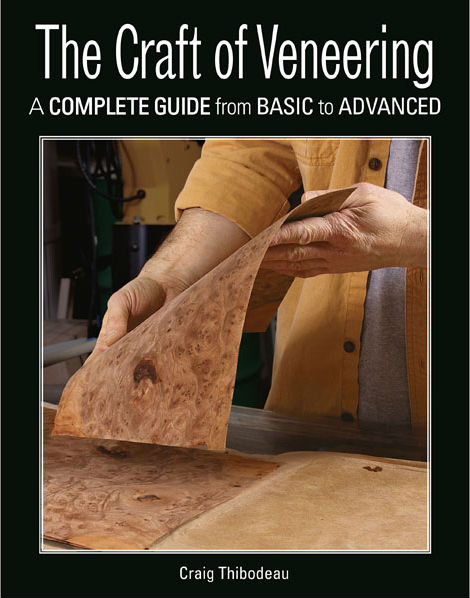
While each has its strong points, none, in my opinion, is as complete an introduction to
veneering as
The Craft of Veneering
by Craig Thibodeau. In it, the author, a longtime practitioner with
many innovative and creative projects behind him, lays out the methods he uses to
achieve exemplary creations. The result is a ready guide to a wide range of veneering
practices that will get you started with this interesting material and whet your appetite for
increasingly challenging projects.
Thibodeau opens his book by exploring how veneer is manufactured, the different
types of veneer, and how it is sold. He then moves on to the buying process, how to
handle and store veneer, how to cut it, and when bookmatches, four-way matches and
radial matches are used, as well as how to tape the joints. His discussion is very practical, and
he gives his tips for materials and tools as well as best practices, a feature he offers
throughout the book.
The next chapter addresses substrates, glues and presses. Although MDF is preferred
as a substrate because of its flat surface and dimensional stability, plywood and even
solid wood can be employed. A variety of glues have utility in different applications,
especially urea formaldehyde glue in marquetry and bent laminations, but he most often
employs
Titebond
. Pressing can be accomplished using clamps for small projects,
but vacuum bags are helpful and, for larger applications, essential. Thibodeau
assesses the
vacuum pressing equipment
available and has recommendations that will fit every
budget.
The meat of the book comes with creating the first veneered project. He works through
the construction of a simple box with a veneered top. He explains the critical need for
each side of the substrate to be veneered. He describes a two-part mirror he
constructed to help him position veneer pieces to get the best bookmatched, four-way
and radial matches before the veneer is cut. The box project is veneered using
hot hide glue
and a
veneer hammer
but could be equally well accomplished using a vacuum press.
The second project is a bookmatched panel for a frame and panel door. Thibodeau
steps through his process, giving careful consideration to final sanding. A four-way
matched panel follows. Here Thibodeau gives special attention to using his two-part
mirror to get the best match, as well as his procedure for stacking and cutting the
veneer. A helpful sidebar shows how holes and damage in the veneer can be repaired.
He then demonstrates how to tape the veneer into a single sheet so it's ready for
application of glue.
The text progresses to a more complex project, a radial-matched tabletop. The process
involves making a full-size template of a section of the tabletop. This is then used to lay
out accurate slices of veneer that will make up the whole pattern. He uses his two-part
mirror to locate and match the individual pieces to assure they will produce the best
match. Thibodeau takes us step by step from cutting to glue-up to sanding and in doing
so makes what seems a daunting project more approachable.
Thibodeau next progresses to marquetry as a special application of veneering to create
more highly decorated projects. It all begins with making drawings of the pictures you
want to use, then selecting and sorting the veneer to produce the desired shapes. This
intricate procedure is thoroughly illustrated in both text and clear photos, making plain
the stages needed to achieve good results. To finish the projects, he discusses sand
shading and final fitting before the glue-up is achieved.
Parquetry follows and employs similar practices, though it presents some special
challenges and can benefit from the practical tips Thibodeau offers. He demonstrates
the creation of a chessboard pattern before showing how to cut veneer to create
diamond cut veneer, Louis cubes that resemble three-dimensional boxes, and
herringbone patterns.
Veneering need not always be applied to flat surfaces. Advanced applications involve
both coves and convex radii. Thibodeau once again demonstrates his methods for
veneering curved surfaces, for which he prefers urea formaldehyde or polyurethane
glues, which produce more rigid glue lines than the Titebond he used at one time.
Clamping poses special problems, and Thibodeau explains his methods for getting
pressure in the right places. He also discusses bent laminations for the structural parts
of the furniture he builds. For these, he favors two-part epoxy, urea formaldehyde or
polyurethane glue because they yield a rigid glue line, no creep at the glue line and
enough open time to glue all the layers.
Edging and crossbanding techniques are used to finish off exposed edges. He
discusses simple veneer edging, curved panel veneer edging, solid wood edging
including curved edging, banding on boxes, and crossbanding with veneer or solid
wood. A special application is waterfall veneer edging.
The final chapter presents a sampling of the varieties of veneer that are available, which
gives the reader a good review and guide to the color and pattern combinations that can
be used.
A strong point of this book is the many color illustrations of each of the steps involved in
the procedures Thibodeau describes. They will make it relatively straightforward to
follow his practices to get started in veneering.
This book is an excellent resource for a woodworker just starting out in veneering. It
gives not only a general guide to the whole range of processes and applications but it is
sufficiently detailed and filled with practical tips to enable those new to veneering to
succeed. At the same time, the illustrations of outstanding projects that accompany
each chapter offer many ideas and much inspiration that will spur further development
in veneering.
Advanced practitioners of veneering will find this book a useful refresher, as well as a
source of inspiration and technical advice on the more advanced topics.
I intend to rely heavily on this book as I begin my foray into veneering. If you too are
just starting out, you won't go wrong with this book, which is the best of several I've
read.
Find out more and purchase
The Craft of Veneering
at Highland Woodworking
J. Norman Reid is a woodworker, writer, and woodworking instructor living in the Blue Ridge Mountains with his wife, a woodshop full of power and hand tools and four cats who think they are cabinetmaker's assistants. He is the author of
Choosing and Using Handplanes
. He can be reached by email at
nreid@fcc.net
.
Return to Wood News Online
|