|
Spoon carving, an ancient practice that has roots not less than two or three thousand
years ago, has recently become a topic of fascination among woodworkers. Informed
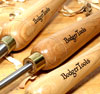
by several books describing the practice and aided by
specialized tool sets
for hollowing
spoon bowls, spoon carving is both accessible and, frankly, fun. Who doesn't need a
few spoons and spatulas to aid their culinary pursuits? Or even, if carving turns out to
touch a deeper passion, items for sale at craft shows?
When the author of
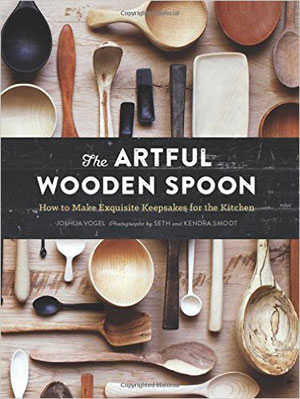
The Artful Wooden Spoon
, Joshua Vogel, took up spoon carving, he had it in mind to
document his procedures so others could replicate them. His goal was a book to
convey his observations. And so, he asked himself just how many spoons would he
need to carve to justify sharing his experiences: a few dozen, perhaps, a hundred
maybe? Vogel set out to carve as many as he could, using a variety of wood sources,
tool sets, designs, and techniques. In the end, I suspect he carved well in excess of
100 spoons, with a range and variety well-evidenced throughout the book. His
outcome: a well-informed guide to spoon carving that combines well-organized
instruction with inspiring examples.
Vogel opens his discussion with a brief history of carved spoons, then offers some
observations about the traditions of crafting, the meaning of creating things by hand,
and the value and uses of wooden spoons. These initial remarks help set up a theme
that runs throughout the book, that spoon carving is far more than a productive effort,
reaching deeper into one's consciousness with the potential to offer a meditative
opportunity.
But the real meat of the book begins with a chapter that provides an overview of the
tools used and the major steps in carving spoons — carving outside curves, inside
curves, edges and transitions, details and ornamentation, tempering and finishing.
Then, with his subject outlined, Vogel turns to practical advice about the nitty gritty:
wood species selection, closed vs. open grained woods, wet vs. dry lumber, carving
with blades vs. abrasive devices, clamping the work, sharpening the tools, rotary
carving, safety, finishing the spoons, and the importance of self-critique to personal
growth and development as a carver.
Although these initial chapters offer enough instruction for beginning carvers to get
organized and start shaping spoons, Vogel further illustrates his points by detailing
three projects of increasing complexity that employ differing tools sets, techniques, and
wood sources. For the first and simplest project, he selects a jointed branch whose
shape will yield a small spoon with a curved handle. He completes this project entirely
with hand tools that are standard in many spoon carving sets, such as the
Narex Starter Kit
.
He describes — and shows in photographs — five techniques for knife work and details
his process for tempering green wood before applying an oil finish.
The second project is created from a stick originally intended as firewood. The piece
was split by axe into an appropriate size free of checks and cracks. Vogel's a strong
advocate for drawing his intended shapes on both the tops and sides of his blanks to
further guide their reduction with a bow saw. He finds a
Pattern Maker's Vise
valuable
for holding the irregularly shaped blanks in various orientations so there's no need to
continually re-clamp them. Once the blank is roughly shaped, he turns to a succession
of rasps, working from rough to smooth teeth to refine the final shape. He gives careful
attention to the transition points, which are keys to the eye-pleasing quality of the final
spoons. Once the outside is shaped, he excavates the bowl with a spoon gouge. The
surfaces are then finished with fine-grained curved rasps. The edges of the bowl get
special attention to assure that they are finely crafted. Sanding follows, as does adding
decorative knife cuts, before finishing the spoon with oil.
The final and most advanced project is a one-cup measuring spoon cut from a blank of
holly lumber. For this project he uses a bandsaw to both cut out the initial outline of the
blank and then, working carefully, giving it a rough shape, he subsequently smooths
with an air-powered rotary burr. Sanding to a finger-satisfying smoothness precedes
the oiling that yields a beautiful and useful kitchen implement.
Vogel's book is highly satisfying. First, it's beautifully written, almost lyrical in tone, and
a great pleasure to read and, as I have, re-read. It's also a beautifully illustrated book,
with professionally photographed images throughout that display the variety of Vogel's
inspirations and document the procedures he employed in creating them. The book is
letter-sized and hardbound with a full color cover that entices the reader to explore its
contents.
This is a very good book for any woodworker who wants to try their hand at carving
spoons. Not only is it an approachable guide to basic spoon carving but it's complete
enough that it may well be the only guide you'd ever need as you explore this medium
of creativity. Other woodworkers will find it a fun read, even if they don't yet imagine
that spoon carving may be a part of their future.
As for me, I'm now inspired to find a thick green branch in my yard, a stick of likely
firewood, and an 8/4 offcut as Vogel did to experiment with new shapes, functions, and
appearances for the utensils with which I cook. Perhaps if you pick up
The Artful Wooden Spoon
, you'll be enticed as I was to add a new dimension to your woodworking
practice.
I love this book and I highly recommend it.
Find out more and purchase
The Artful Wooden Spoon
at Highland Woodworking
J. Norman Reid is a woodworker, writer, photographer and woodworking instructor living in Virginia's Blue Ridge Mountains with his wife, a woodshop full of power and hand tools and two cats who think they are cabinetmaker's assistants. He is the author of
Choosing and Using Handplanes: All You Need to Know to Get Started Planing by Hand,
and co-owner of Shenandoah Tool Works. He can be reached by email at
jnreid45@gmail.com
.
Return to Wood News Online
|