|
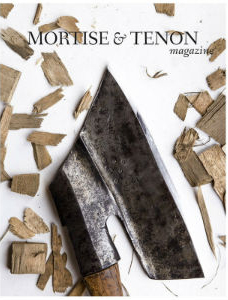
Once again, Joshua Klein has brought forth an interesting mix of articles expressing
fresh ideas about woodworking topics in Issue 8 of
Mortise & Tenon Magazine
. As always, emphasis is on hand tool
woodworking, with a strong sub-emphasis on living close to nature. The result is a
refreshing diversion from the overwhelmingly high technology world so far divergent
from the earth from which life springs. Especially now, when we are largely cut off from
one another by either forced or self-imposed isolation, this issue offers welcome relief.
The lead article, by New Brunswick woodworker Harry Bryan, introduces what he calls
"intermediate technology" for the woodshop. In the early 1970s, Bryan set out to live in a
way that made minimal demands on the earth's resources. Inspired by Helen and Scott
Nearing and later E. F. Schumacher's
Small is Beautiful
, he set up off the grid, without a
complete wind and solar power base but rather an intermediate solution. While few of
his tools—a thickness planer, tablesaw, and large bandsaw—are powered by his solar
cells, more of his tools are human powered using treadles, hand cranks, and even a 10
speed bicycle mechanism that drives one of his band saws. Hand tools make up the
rest of his equipment. His belief is that advanced society doesn't know when enough is
enough. His intermediate solution between electric power work and human-powered
tools is his attempt to attain a balance that doesn't exceed "enough."
Joshua Klein's article "Showing What is Possible" recounts the visit by an international
team of hand tool woodworkers to build a timbered blacksmith shop near his woodshop.
Organized by the French-based Charpentiers Sans Frontières (Carpenters Without
Borders), the team built a 16 x 25' blacksmith shop on Klein's property. Not only did
they raise the structure, but they taught each other new ways of working large
timbers—the Europeans teaching the North Americans, and the North Americans
returning the favor.
The article describes the procedures the team followed in building the structure. But the
real lesson was in the camaraderie that was shared and in learning that there is no one
right way to do the work.
In what I thought was one of the most delightful articles in the issue, Cameron Turner, a
high school English teacher, relates how he introduced woodworking into his American
literature courses. In a course that ordinarily teaches the writings of the likes of
Emerson and Thoreau, Turner's three classes of 11th grade girls were given an
opportunity to build a replica of the desk on which Thoreau wrote Walden and his
famous essay on civil disobedience. Given no grades on their shop project, the girls
took to it eagerly and quickly learned new skills and experienced the joy of
discovery. Turner reports that this novel approach helped the students to feel more
empowered and to develop a greater appreciation of beauty and for the value of work.
An interview with Roy Underhill, the self-styled Subversive Woodwright, follows. The
interview explores Roy's career development and his approach to making his fabled TV
program so successful. Now he's focused on teaching, something he loves to do. His
current venture, the Woodwright's School, started off slow but now demand exceeds the
supply of classroom spaces, since his offerings are a part of the "experience economy."
His biggest regret is that he doesn't get more African-American students, in whom he'd
like to rekindle the spirit of such outstanding practitioners as John Hemmings and
Thomas Day.
Amy Umbrel, a carver of spoons and other utensils, shares her experience of finding a
place for herself in the world of crafting. Her belief is that it's important for her to be tied
to the spirit of the natural environment around her and that her work uses local natural
materials rather than wood imported from elsewhere. Her gentle essay offers a calming
antidote to the hectic search to find meaning in an otherwise chaotic world.
Each issue of Mortise & Tenon contains an examination of a period piece, its details
and construction. In this issue, the piece is a grain-painted chest-over-drawer dating
from the late 18th to early 19th century. The piece, built of pine, is thoroughly documented
with both dimensions and ample photographs.
One of the most fascinating articles in the issue is Dr. Mike Epworth's tale of the legend
of the Jimmy Possum chair. The chairs are traditional to the southernmost island of
Tasmania, a part of Australia. Legend has it that the design originated with one Jimmy
Possum, said to have lived in the hollow of a large tree. But who was Jimmy Possum?
Was he an Irish famine refugee, a resettled English convict, or a member of the First
Nation, Australia's aborigines? Or did he never exist all? Epworth reports on his attempt
to discover the truth about Jimmy Possum and the chairs that emanated from his
tradition.
The chairs resemble Irish hedge chairs in basic design but differ in fundamental ways.
Unlike any other chairs, the legs extend through the seat to terminate in the chair's arms. The shape of the legs is such that the seat is wedged in place by the leg taper. The market for original chairs attributed to Jimmy Possum and other early makers
at one time drove prices as high as $80,000. But copying, theft, and fakes eventually
drove the market down. Epworth started making his own version of Jimmy Possum
chairs several decades ago, eventually converting from a machine shop to a backpack
toolkit like Jimmy Possum would have used that enables him to do his chair work
anywhere he chooses.
Michael Updegraff explores the methods by which one can attempt to discern the
history of older pieces. Given the sparsity of printed guides to woodworking techniques
in earlier times, how can we recover those techniques so they can be applied efficiently
today to craft the kind of quality furniture that emanated from those fabled workshops?
A variety of documentation can be researched, including published works where they
exist, ledgers, tax and estate records, journals and diaries, as well as surviving tools,
shops, and of course examples of the furniture itself. For the latter, reading the tool
marks can be a valuable source of information about the methods employed, and
Updegraff lays out a series of methods that can be applied to this task. The article is
supplemented by a field guide to tool marks that offers, with illustrations, helpful tips on
what to look for.
Next follows an essay drawn from Joseph Park's early 20th century book on manual
training. His argument, quite relevant to today, is that training in the manual arts is
important for child development. Not only does it foster physical development, but he
argues that it helps develop aesthetic tastes, engages intellect, builds character, and of
course, teaches concrete skills that can be applied throughout life.
This issue concludes with a review of Aldren Watson's excellent book,
Hand Tools: Their Ways and Workings
, an encyclopedic guide to hand tools that's beautifully
illustrated by the author's hand drawings.
As is customary for
Mortise & Tenon Magazine
, this issue is richly illustrated with
color photographs and, where helpful, drawings and supplementary tables, making it a
feast for the eyes as well as for the mind.
There have been so many fascinating issues of Mortise & Tenon since it originated
that it's impossible for me to place this one within the ranks of the others. Frankly, it's a
darn good issue, easily the equal of the others if not their better. It's a welcome read
that's as easy on the mind as it is on the eyes. If you've liked the preceding issues,
you're sure to love this one.
Find out more and purchase
Mortise & Tenon Magazine
at Highland Woodworking
J. Norman Reid is a woodworker, writer, and woodworking instructor living in the Blue Ridge Mountains with his wife, a woodshop full of power and hand tools and four cats who think they are cabinetmaker's assistants. He is the author of
Choosing and Using Handplanes
. He can be reached by email at
nreid@fcc.net
.
Return to Wood News Online
|