|
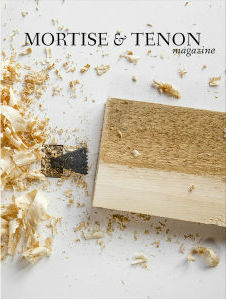
As we've come to expect, the latest issue of
Mortise & Tenon Magazine
, the seventh in this
remarkable series, is an eclectic collection of articles that probe various aspects of hand
tool woodworking, craftsmanship and design. Pictorially exciting, informative, at times
mind-expanding, it's a fun read. As was true of its predecessor volumes, it makes an
exemplary contribution to woodworking literature that is unique in orientation.
The volume opens with an interview with a Maine handtool woodworker, Peter Lamb.
A former museum curator, Lamb learned early to "make or do without," a philosophy
that explains the many handmade or retooled woodworking implements he uses in his
varied crafting activities. The interview explores his relationships with Bill Coperthwaite
and Wille Sunqvist and his beliefs that working with his hands is more than a way of
doing, but as he says of the handcraft community, "a reaffirmation of the healing power
of nature."
Editor Joshua Klein next delves into an examination of David Pye's often misunderstood
concept of the "workmanship of risk." A believer that diversity of work is "the tonic our
souls require," Pye distinguishes between the "workmanship of risk," or mostly hand tool
craftsmanship, and the "workmanship of certainty," a largely machine-based, high
productivity product. But the distinction is not based on the source of power—some
power tools require great dexterity and reflect the workmanship of risk. Nor is the
distinction about the quality of the result, which can vary no matter the workmanship
method. In the end, Pye makes another distinction, between "regulated" workmanship
and "free" workmanship. The former may use jigs and fixtures to establish conformity to
a pattern; the latter, by contrast, is more like a sketch in which the finished product may
deviate from the original intent. Neither is inherently good or bad, nor is free
workmanship a guarantee of greater quality. Rather, their meaning must be interpreted
in relation to the current time and circumstances.
Bill Pavlak, a joiner in the Williamsburg Anthony Hay Shop, assesses two 18th century
cabriole legs unearthed during a restoration of the shop some six decades ago. In an
interesting archeological essay, Pavlak asks about the intended uses of the legs and
how they happened to lie buried in the silt of a creek bed for two centuries. After
speculating on these subjects, he offers observations about the methods used for their construction before attempting to execute the legs using the same techniques and
making the same mistakes as the original makers did.
Michael Updegraff explores several workholding methods drawn from three traditions.
Western traditions are the most familiar, and Updegraff discusses how he graduated
from a bench vise to other, more workpiece-friendly methods such as planing stops and
sawbenches. He contrasts these methods with those of Japanese woodworkers, in
which the worker sits on the floor and works in a pull rather than a push direction. North
American Native Americans employed yet another tradition, holding the workpiece with
one hand while working it with the other. Updegraff concludes that we don't always
need new tools for workholding and that alternatives are available if we are open to
them.
Richard Arnold reports that Walter Rose, in
The Village Carpenter
, states that making a
four-panel door was a good day's work in the mid-19th century. Arnold sets out to
duplicate the feat using period tools. He estimated that in Rose's day, a good day's
work was about 11 hours. Arnold finished his door in 10-1/2 hours, concluding that he
had indeed done a good day's work.
One of the most enlightening articles in the volume is by Brother Arnold Hadd, who
debunks some myths about Shakerism and Shaker craftsmanship. Shakers did not see
themselves as craftsmen, he says, but as farmers first, using the winter months to build
needed things. While they sought perfection in all they did, not all their work was
perfect, and builders' skills grew as their experience developed over time. However,
only the best work is shown in galleries and publications, leading to a distorted view of
the whole body of Shaker work. Though Shaker pieces are often described as simple,
they are often anything but so. Nor was all "Shaker" work produced by Shakers
themselves, for they often hired workers to manufacture goods for sale. And, he
asserts, Shakerism is not dead as is widely supposed, for there is new life in Maine's
Sabbathday Lake community.
Keiran Binnie takes a look at Welsh vernacular furniture, which is designed around
naturally curved limbs. Typically made by village carpenters rather than professional
furnituremakers, it used a variety of woods — whatever was at hand. Though some
pieces include turned parts, mostly they are shaped by hand. Binnie, drawn to a
specific chair probably dating from about 1760, sets out to build one like it, and his
article chronicles the challenges he faced in doing so.
A regular feature of Mortise & Tenon is a visual examination of a historic piece, this time
an early 18th century high chest of drawers. Modified several times over various
restorations, the piece is described in enough detail to understand its construction or to
be recreated if desired.
Jarrod Dahl explores what he calls "the new wood culture," a term applied to green
woodworking that pays homage to older traditions as well as new processes. He
argues that green woodworking provides a direct connection to the earth and is thus a
therapeutic antidote to the depression that is so often found in modern society. While
he favors hand tool work, he acknowledges the value of machine tools and dried lumber
for the independent woodworker to maintain profit margins. In the end he concludes
that the new wood culture is best defined as the making and use of hand crafted
products, rather than by a limited view of how they are made.
In an important article, George Walker contrasts the ancient view of freedom—working
in the pursuit of perfection — with the modern view — freedom as flexibility of choice. He
reflects on three ancient axioms of perfection in design: strength and durability; function;
and beauty. The ancients argued that all three were essential to good work. But the
Industrial Revolution altered the ruling axioms, first emphasizing form as following
function and replacing beauty, leading to a sterility and soul-less quality in modern
furniture. At the same time, the axiom of durability was replaced by one of disposability.
Walker opines that though the traditional axioms have thus been displaced, internet
communications offer hope for revival of the traditional axioms of good design through a
community of makers.
The volume concludes with Sam DeSocio's review of Drew Langsner's 1978 classic
Country Woodcraft
and its impact on the green woodworking movement.
As always, beautifully photographed and laid out, this issue is a feast for the eyes and a
worthy collector's item. Certainly, green woodworkers and hand tool enthusiasts will
greatly appreciate the attention to their ways of working. But the volume is much more
than that, and those interested in the history of woodworking and issues of design will
also find much of value. Armchair woodworkers will find it a good read and a mind-
stretching exercise. As always, I enjoyed devouring this issue and look forward to
whatever editor Joshua Klein comes up with for his next issue.
Find out more and purchase
Mortise & Tenon Magazine
at Highland Woodworking.
J. Norman Reid is a woodworker, writer, and woodworking instructor living in the Blue Ridge Mountains with his wife, a woodshop full of power and hand tools and four cats who think they are cabinetmaker's assistants. He is the author of
Choosing and Using Handplanes
. He can be reached by email at
nreid@fcc.net
.
Return to Wood News Online
|