|
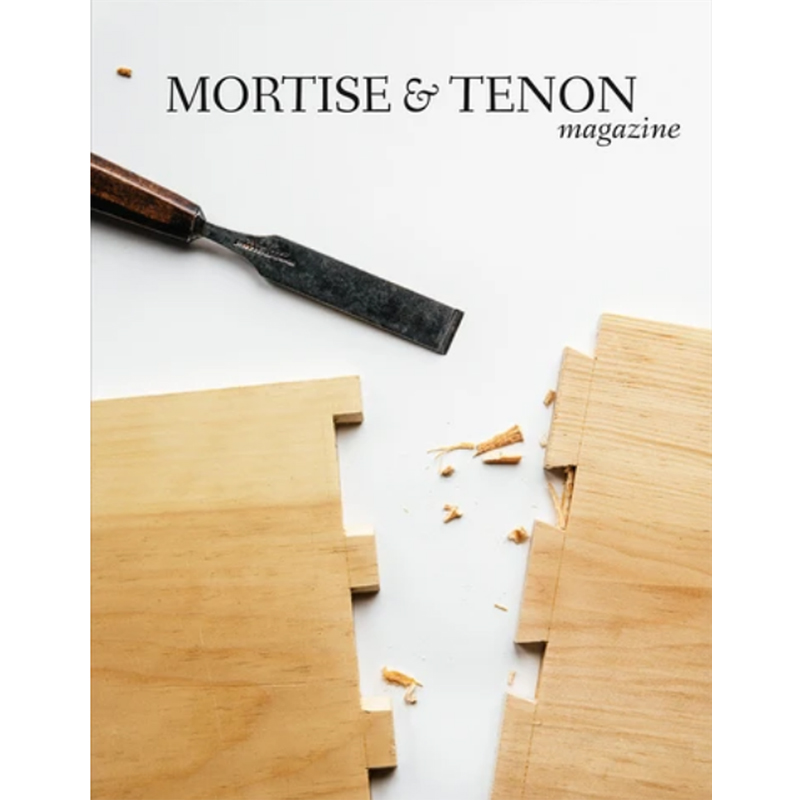
Another delightful issue of
Mortise & Tenon Magazine
has arrived. How refreshing it is
to see that this venture, so recently a start-up, has thrived and is now in its eleventh
release. It continues to add needed diversity and richness to the literature available to
woodworkers around the world who strive to work with their hands and to others who
appreciate the means and workmanship of those who do.
Issue 11 is like its predecessors, a bit eclectic, though focused on human-centered craft
and the traditions of woodworking by hand. It's built of a variety of interesting topics
around this general theme. As always, it's richly illustrated by generous color
photographs that amplify its words.
The opening essay by Michael Updegraff celebrates the half century since the initiation
of
Foxfire
. Begun by Georgia English teacher Eliot Wigginton to stimulate the attention
to learning by troubled teenage boys, this student-produced project quickly grew from a
small, locally printed pamphlet into an international sensation. It soon achieved its
intended purpose: to motivate reluctant 10th graders into roles of greater responsibility
and interest in learning. But perhaps more important, by recognizing the significance of
their local heritage,
Foxfire
expanded their pride and self-confidence while preserving
traditions being rapidly lost as the older generation disappeared. Eventually, the
publication was adopted by Doubleday, and by 1975 over a million copies had been
sold and a huge cult following established.
Foxfire
contributed in important ways to both
the crafting and homesteading movements. Some 11 issues followed the initial volume.
But despite its commercial success, the biggest payoff for the students was less
financial than moral, best captured by the phrase, "remember who you are."
A little confession is in order here. As I read this article, I was moved by Wigginton's
inspiration and the achievements of successive groups of 10th graders. It gave me chills
of delight and a renewed faith in the exceptional things that ordinary people can create
through effort alone.
The following essay, "Warp & Weft," by Nevan Carling, details the restoration of an 18th
century loom that for a long time populated the back walls of the Liberty Tool Company.
Fascinated by it, Carling determined to understand its provenance and restore it to
operating condition. He first studied loom styles to understand their intriguing designs, operations, and the stresses placed on them in use. This loom was initially identified as
being of Connecticut manufacture, but Carling's research determined that it was in fact
made by one Manwarren Beal on Beal's Island, Maine, for his wife Lydia. Timber
framed and unusually made of birch, the loom incorporated crude, locally made metal
parts. Carling taught himself to weave on it, then wove nine yards of denim from which
he made himself a pair of jeans before donating the loom to the Beal's Island Historical
Society and Museum. Carling's larger point is that there is much to be gained from the
cross-fertilization of academic research with practice in understanding the provenance
and construction of traditional pieces such as Lydia's loom.
Gustave Rémon sets out to explain the design and uses of the medieval socket axe.
Socket axes are constructed like socket chisels, with their handles fit into gradually
narrowing hollows in the heads that normally do not continue to the top and that unlike
more common axes are not wedged in place. Socket axes date from at least the 12th
century and were especially popular in the 14th -16th centuries all over Europe. Some
employed L-shaped heads, others triangular. After the 16th century they gradually
disappeared, though some persisted into the early 20th century in Normandy. Rémon
commissioned one for himself. Socket axes have the advantage of being easy to
rehandle, should a handle break or a different style be needed for a particular job. They
are especially well-suited for hewing. They're difficult to make, though, involving
multiple forge welds sometimes requiring thin metal stock. Rémon concludes by
discussing his hewing techniques using his socket axe.
Jeremy Tritchler served for a time as an apprentice at the Anthony Hay cabinetmaker's
shop at Colonial Williamsburg. He describes this once-in-a-lifetime experience in which
he first learned to draw by hand, a skill that proved valuable not only in developing
designs but also in guiding his hands while working with wood. He was also able to
study early pieces up close to understand their construction methods. During his time
at the shop, he was able to complete several pieces, including a tea table, which he
describes within the article.
In an essay entitled "The Speed," Elia Bizzarri traces the need for increasing speed in
chair production throughout the 19th century. "Fancy chairs" were the name for fanciful
designs that incorporated such things as cane seats and post and rung joinery. Their
introduction spurred rapid growth in demand for chairs in the early 19th century. Prices
then fell and the pressure was on to increase the speed of production to keep pace by
lowering costs. Windsor chairs were designed for just this speed of production, with
spindles turned on lathes. At the same time, spindle lengths were shortened so they
could be made more quickly, and tight grained woods were substituted so there'd be no
pores to fill before finishing. Story sticks took the place of measuring tools. To better
understand the historic movement to increase speed, Bizzarri worked through the
processes himself to recreate them and improve his own speed.
The centerfold, if you will, of this issue is an early 19th century chest of drawers.
Featuring three evenly sized drawers, it was built of walnut, with bookmatched walnut
drawer fronts and pine secondary wood. As usual, the article displays enough detail
that the piece can be recreated in one's workshop. The chest remains in solid condition
despite its age.
Joshua Klein explores "Finding the Groove" in achieving efficiency in mass production in
a hand tool environment. He and Michael Updegraff had some 80 wooden slip cases to
make to hold issues 1-10 of
Mortise & Tenon
. Their choice: do them as one-of-a-kind
pieces or batch process them. They chose the latter method and experimented with
ways to make it work most efficiently. The article, which documents their processes,
notes that work can proceed more quickly when a repetitive rhythm is achieved, though
breaks are sometimes needed to remain fresh. Collaboration can work well on some
aspects, but joinery worked best for them as an individual effort due to personally
distinct methods. Shared labor helps, though, as does music—even singing, a
traditional practice.
Dr. Mike Epworth, in an article entitled "The Drawknife and the Butterfly Effect,"
compares the work of two Tasmanian chairmakers. Jimmy Possum, whose work was
featured in an earlier issue, employed a drawknife to shape legs and spindles. George
Peddle, who worked in the same area, used lathes in his factory. Peddles's chairs were
fancier and sold to the upwardly mobile middle classes. Possum's ruder chairs went to
poorer farmers. Epworth, taken with Possum's methods, set out to make his own
chairs. He notes that there are distinct advantages to working with a drawknife: you can
work anywhere and take the tool to the timber, rather than haul the wood into the shop,
or you can work under cover. He also notes that the drawknife encourages social
interaction and community creation which industrial settings do not. Like the invisible
effects a butterfly's wings have on modifying larger weather patterns, Epworth argues
that handwork such as this can also spawn larger social benefits.
Hunter Zyriek-Rhodes tells what's known about Tennessee chairmaker Richard Poynor.
Born into slavery in Virginia, he was taken by his enslaver to Williamson County,
Tennessee. He learned chairmaking from his enslaver and probably many of
his chairs were sold in that man's name before the latter died in 1848. After that time,
by some means Poynor achieved his freedom, whether by self-purchase or
manumission, and from 1849 he began selling chairs of his own modified design in a
variety of configurations. Those chairs, whose parts were turned by a horse-drawn
lathe, are now highly prized historical artifacts.
The issue is finished with Ray Defteros's review of John Ruskin's
Unto This Last
, a
series of brief essays on the value of work and fair exchange for the worth of craft.
These thoughtful essays inspired much critical thought and are said to have influenced the likes of Mahatma Gandhi, Marcel Proust, Leo Tolstoy, and UK Prime Minister
Clement Atlee. Aspiring to associate myself with that panoply, I ordered a (used) copy
for myself. A little incisive thought about things that matter never hurt anyone, I figure.
This is a rich and inviting issue. Anyone with a fancy for hand tool woodworking,
whether they actually practice it in their own shop, will come away refreshed and
inspired from a reading. There is much of value to be gleaned from its pages.
Find out more and purchase
Mortise & Tenon Magazine, Issue 11
at Highland Woodworking
J. Norman Reid is a woodworker, writer, photographer and woodworking instructor living in Virginia's Blue Ridge Mountains with his wife, a woodshop full of power and hand tools and two cats who think they are cabinetmaker's assistants. He is the author of
Choosing and Using Handplanes: All You Need to Know to Get Started Planing by Hand,
and co-owner of Shenandoah Tool Works. He can be reached by email at
jnreid45@gmail.com
.
Return to Wood News Online
|