|
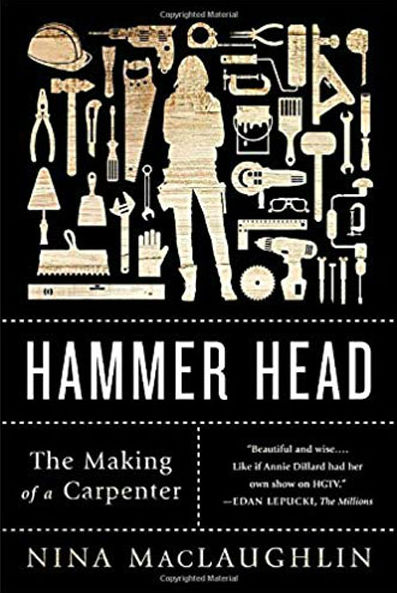
The author of
Hammer Head: The Making of a Carpenter
, Nina MacLaughlin, gave up her young career as a Boston
journalist to become she did not know what. She only knew that the newspaper work
she thought she loved had become boring, so much so that she quit her job with no
prospects in sight. In consequence, she was resigned to scanning the want ads daily
for something, anything that might prove interesting and profitable. One day, an ad
appeared from a woman carpenter seeking an assistant. MacLaughlin applied, one of
hundreds to do so. Somehow, she made the first cut based on a terse bio statement
that reflected her innocence of things carpentry. But, she made the short list. Finally,
she had a one-day apprenticeship, and, despite several mistakes, she was given the
job. But doing what? She knew nothing of carpentry, its tools, its methods, its
terminology. What follows is the twisted tale of how she muddled her way through from
ignorant tool-toter to accomplished carpenter able to complete projects on her own.
On its face, Hammer Head is an autobiographical account of MacLaughlin's growth and
development as a carpenter. And it is certainly that, replete with tales of trials and
plenty of errors as she struggled to grasp the diversity and intricacy of general
carpentry. But her story runs deeper than an account of her apprenticeship. It's filled
with digressions into the genesis of the tools she learns to use. And these excursions
lead to subtle analogies to lessons of life she extracts from pondering the tools and
processes of working wood.
The book is charmingly written with many references to classical literature at
appropriate points. These keep her focus at a high but nevertheless approachable
plane. They're not only enlightening and interesting, but in some cases, they're
surprising. And often they're humorous. I sometimes found myself laughing out loud at
the messes she worked herself into. In many places, I encountered "ah hah" and "been
there" situations that made me appreciate both her learning dilemmas and my own
screw-ups, er, learning opportunities.
Each of the six chapters is loosely organized around one tool and its related uses.
Chapter 1 is the tape measure, and MacLaughlin employs it to collect her early
experiences learning to measure things at an appropriate degree of accuracy for carpentry. As she does, she delves into the history of measurement, how the systems
employed in modern times came to be used, and some of the peculiarities of their
origins. She relates the story of one Oliver Smoot, who in 1958 was tipped over and
over, head over heels, by his MIT fraternity mates, so his body would measure the
length of the bridge from Boston to Cambridge. Thus originated the unit of measure
known as the Smoot. In one of the strange twists of fate, the same Oliver Smoot went
on in his career to head up both the American National Standards Institute and the
International Organization for Standardization. Truth is, as they say, stranger than
fiction.
Chapter 2 is themed on the hammer. Amid stories of her experiences learning to use
the hammer is the tale of the Hammer Museum in Haines, Alaska. But more important
are her experiences trying to drive nails without bending them. And using a claw
hammer to remove dilapidated stair treads by working from the top of the basement
stairs to its bottom, then finding no good way to climb back out of the dark lower space.
Ah, the perils of inexperience.
Chapter 3 is dedicated to the screwdriver. This, of course, opens up the whole subject
of screws, their fairly recent appearance in woodworking history, and the etymology of
the term screw. Here she learns an important lesson: "Half a job is learning how to fix
mistakes." Her inability to drive screws into a plastic material taught her the value of
drilling pilot screws. Her self-anger at this frustrating situation pushed her to say "screw
it" and walk away in disgust. Better, though, was the advice she took from Samuel
Beckett: "Try again. Fail again. Fail better."
Chapter 4 relates to the clamp. This chapter is associated with a period in which there
were no carpentry jobs to be had and she entered a time of unemployment. She was,
as it turns out, unemployed for months. Her own circumstances paralleled a similar
painful period in which her father had lost his job and sat idle, unable or unwilling to shift
directions to find gainful employment. What you do professionally, it turns out, is a big
part of who you are, and without something to do, it raises questions about your
personal identity. Missing, in such a case, is the guidance, the order and stability that
can be offered by a clamp. So in life as in woodworking. Eventually, work returned and
she was able to climb out of this uncertainty and regain her sense of order and self-
identification.
Chapter 5 honors the saw. In the course of her work, she learned to use many different
types of saw and came to understand which was most appropriate to each situation.
The saw, it is said, was an ancient Greek invention by Perdix, nephew of the ill-fated
Daedalus, who one day spied the bare spine of a bony fish and reasoned that such a
thing in steel would be just the thing to sever wood fibers. Or so they say. The final chapter is dedicated to the level. Here she relates her first job entirely on her
own, making a set of built-in bookcases for her father, and her success—mostly—at
ensuring they were level, given the uneven floors and walls. At the same time,
MacLaughlin draws a parallel to life, to the value of keeping things on an even keel.
The bookcase helped her establish a tighter bond with her father, a heretofore
somewhat remote relationship, and exemplified squaring up her own life.
This paperback book is at once an easy and a fun read. It will have broad appeal for its
amusing and knowing look at the familiar and less well-known in the world of tools and
practices of carpentry. It is at the same time the story of perseverance in the face of
frustrations and adversity for a woman in an almost wholly male-dominated profession.
There is here an important but subtle life lesson embedded in the mirth. I found much I
could relate to in this book. And I thoroughly enjoyed reading it. You will too.
Find out more and purchase
Hammer Head: The Making of a Carpenter
at Highland Woodworking
J. Norman Reid is a woodworker, writer, and woodworking instructor living in the Blue Ridge Mountains with his wife, a woodshop full of power and hand tools and four cats who think they are cabinetmaker's assistants. He is the author of
Choosing and Using Handplanes
. He can be reached by email at
nreid@fcc.net
.
Return to Wood News Online
|