|
The subtitle of this book
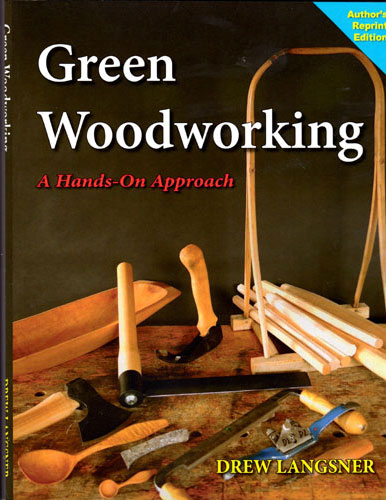
Green Woodworking - "A Hands-On Approach"
- points to a highly important aspect
of this book. This is no mere treatise on working with green wood. Rather, it's both an
introductory guide to key green woodworking methods and a set of practical projects to
get you started on the road to the satisfaction of completed projects. Green
woodworking is what the name suggests: woodworking using relatively wet, fresh-cut
wood from a variety of species. The principal method for working green wood is riving
it, rather than rip sawing it. This splits the wood along the grain and, if the grain is
relatively straight, yields stronger wood and less waste.
Langsner tells the story of how he came to be a green woodworker, studying with a
traditional Swiss cooper while on a European tour with his wife. Following his return to
the U.S., he settled in western North Carolina to homestead, farm and work green
wood.
Following a chapter describing the history of green woodworking in America, he turns to
the raw materials of green woodworking: wood harvested directly from forests. While
wood is readily available, Langsner emphasizes the importance of husbanding it. Often,
a species is useful only for a specific craft, such as basketry. Straight-grained woods
are often the best; figured wood, though beautiful and useful for traditional
cabinetmaking, is hard to work with due to its swirling or interlocked grain. Ring-porous
woods like oak split the best. Forest-grown trees have the straightest wood grain and
the fewest knots. Langsner includes several tables with useful data on wood
characteristics such as riving quality and bendability that will be valuable to green
woodworkers.
Langsner next turns to specific green woodworking techniques. He begins with knife
work, a basic skill in green woodworking. Knives are very important, especially for
carving spoons and bowls, both popular projects. The best knife is a
sloyd knife
with a
short blade, with hard and soft steel laminated to combine durability with strength. He
describes his method for sharpening knives. A sidebar tells the reader how to make a
carving knife. The chapter concludes with a project, described in text and with photos,
to carve a spoon. A diagram shows a variety of spoon finial shapes.
The succeeding chapter addresses hewing. Langsner describes the types of axes,
hatchets and adzes and offers useful advice on selecting them. He also gives advice
on sharpening axes and explores techniques for using them that include body
mechanics, stance and the holding ability of stumps. The project for this chapter is
hewing a large bowl.
Riving is the means by which logs are split into useful billets. This yields stronger
pieces than sawn wood because it follows grain lines. Ring porous wood usually
cleaves well, except for elm, which has interlocked grain. To split large logs, wedges
and wooden gluts are used to open the split. A sidebar shows how to make your own
clubs and gluts. Langsner shows the best technique to rive wood. The project for this
chapter is a garden hurdle, a fence that can be used as a trellis or a temporary stock
enclosure. A sidebar shows how to make ash splints for chair weaving.
Shaving is a technique similar to knife work, except that it employs a
drawknife
or
spokeshave
. Although it's often used with green wood, when used on dried wood
shaved surfaces can be especially attractive. A shaving horse is used to hold wood
while it's being worked. Langsner's discussion includes both shaving techniques and
sharpening. Projects include shaving cylinders and wide flutes and making a grass and
leaf rake. A final sidebar considers how to modify the Kunz half-round spokeshave to
make it ready for use.
Boring with spoon bits creates slightly oval holes that don't penetrate the reverse side,
since there's no lead screw to poke through. Duck bill bits are shaped so they have
reduced friction when boring at deeper depths.
Auger bits
use lead screws to pull the
bit into the wood. Jennings bits have two continuous spirals and are especially good for
hard wood. Irwin bits, which are less expensive, cut faster. Langsner considers other
bits as well, including twist, brad point and
Forstner bits
, along with several styles of
braces. A sidebar shows how to sharpen auger bits. The project for this chapter is a
pair of lightweight trestles.
Bending wood has a long history of use in America. Native Americans bent wood for
snowshoes, canoes, sleds, toboggans and even box sides. Bending has the advantage
of being strong because it uses riven wood. It can result in thinner boards than
industrial bending. Thin green wood can sometimes be bent without the use of steam,
though thick stock needs to be steamed to soften it. Langsner discusses bending with
steam and hot water and the use of a bending jig. The project is a bent wood firewood
carrier.
Most green wood joinery uses round tenons inserted in bored holes. Langsner uses the
wet to dry joinery method, with a dry tenon inserted into a wet mortise. Once the joint
shrinks, it results in a tight fit. Langsner uses white glue rather than yellow wood glue but offers the opinion that
hide glue
may be best because of its reversibility. The project
for this chapter is a post and rung stool.
A large final section of the book is a set of interesting profiles of leading green
woodworkers, whose work extends to several types of chairmaking, basketry, bowls and
birchbark canoes.
Appendices describe how to make your own shaving horse and to make bark seating
for chairs.
This book stands out from similar books by its emphasis on practical application of the
techniques described. It's intended as a course in green woodworking for the
woodworker who desires to learn the craft. Although Langsner believes there's much to
be quickly gained by participating in classes that give practical experience,
woodworkers can nonetheless learn much on their own by studying and working this
book's projects.
While it's an interesting read, this book is probably not for everyone. However,
woodworkers who aspire to learn one or more green woodworking techniques or who
are contemplating homesteading should consider this book to be essential.
Find out more and purchase
Green Woodworking
J. Norman Reid is a woodworker, writer, and woodworking instructor living in the Blue Ridge Mountains with his wife, a woodshop full of power and hand tools and four cats who think they are cabinetmaker's assistants. He is the author of
Choosing and Using Handplanes
.
He can be reached by email at
nreid@fcc.net
.
Return to Wood News Online
|