|
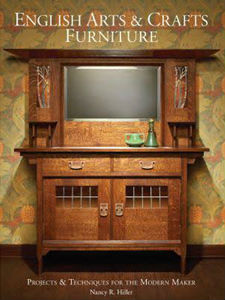
If you think about Arts & Crafts as a style, Nancy Hiller's fine new book
English Arts & Crafts Furniture
will help
disabuse you of that conception. Certainly, there are characteristic stylistic traits of the
furniture and the other crafts it produced. But Arts & Crafts was no single style; it is,
rather, better understood as both a set of design principles and a movement driven by
larger social and economic objectives.
To help us understand the English Arts & Crafts movement and the furniture it
produced, Hiller devotes careful attention to its theoretical roots. She lays out John
Ruskin's six elements of Gothic, which laid the basis for Arts & Craft design principles,
and she explains how these came to be interpreted in the variety of designs that made
up Arts & Crafts furniture.
She also helps us comprehend how these principles supported the social movement
that Arts & Crafts represented. She emphasizes two features of the movement: its
belief that things of beauty should be available for the inspiration of all, not merely the
wealthy; and the tenet that good work should be its own reward. These objectives were
formed in reaction to several contemporary trends: the soul-depriving conditions in
mechanized factories, the poor quality of goods available to the general populace, and
the declining competitiveness of British goods resulting from a comparative dearth of
quality design.
Throughout her well-crafted text, Hiller introduces important biographical material about
the key figures who defined the movement, including the staid theoretician John Ruskin
and the indefatigable and multi-talented William Morris, as well as the artisans whose
work she chooses to exemplify in the book.
So, just what is this book? It is, first, an explanation of the English Arts & Crafts
movement, its roots and its evolution. Then, it's a practical lesson in building three
interesting examples of English Arts & Crafts furniture that span a part of the
movement's great stylistic diversity. Though the projects occupy most of the book's
content, it's impossible to comprehend them as examples of English Arts & Crafts
without first understanding the movement itself.
Hiller chooses as her first project a chair by C.F.A. Voysey that features a two-heart
splat back, a woven rush seat and exaggerated finials above a gently sculpted crest rail.
It's a simplistic yet sensual design that reflects the Arts & Crafts principles of plainness
and rigidity, reflectivity of nature, and the seeming incongruousness of movement. She
chooses the original oak for the build and guides us through the construction of the
chair as a not-quite-faithful copy of Voysey's original, with drawings, color photographs
and a careful description of each step in the building process. She describes it as a
relatively easy build for a chair, given that all joints are at 90 degrees. A biography of
Cathryn Peters, her rush weaver, accompanies a brief exploration of rush weaving for
chair seats.
The second and more challenging project is a sideboard by Harris Lebus. Lebus was a
manufacturer she came to admire before she knew who he was. She'd unknowingly
seen and built examples of his work before identifying the provenance of this less-well-known builder. Lebus's furniture was mostly factory-built, contrary to the craftsmanship
ideal of the Arts & Crafts movement. It was mostly made of oak and featured greatly
exaggerated bevels, bracket-supported overhangs, ring-turned feet, and adornments of
beaten copper panels and heavy gothic hardware.
Again, Hiller crafts her replica from the traditional oak, detailing the construction step-by-step so the piece can be built in home workshops. Brief biographies of Anne Ryan
Miller, who made the glasswork for the project, and Adam Nahas, the metalsmith who
fashioned the hardware, are included.
The final, and most complex, project is a hayrake table designed by Ernest Gimson.
Following an exploration of Gimson's association with Ernest and Sidney Barnsley,
Hiller dives into the construction of the table. In part to provide American readers with
an alternative in keeping with the rural character of the piece, she elects to eschew the
traditional oak and chooses figured sassafras for this build. The dimensions, modified
slightly from the original, are given along with detailed drawings. The primary challenge
in building the table lies in fitting the joinery for the curved hayrake struts that are at the
core of the table's reflection of a rural esthetic. Hiller offers clear advice on solving
problems in the table's construction. The legs are decorated with chamfers—a frequent
feature of English Arts & Crafts furniture—and decorative gouging.
It would be hard to say that the projects presented in this book are broadly
representative of English Arts & Crafts furniture. They are, rather, three exemplary
pieces that Hiller finds appealing and that will make interesting and challenging builds
by her readers. The products of the English Arts & Crafts movement are far too diverse
and interpretations of Ruskin's design principles too varied to be captured in so small a
volume. What we are left with is a sound understanding of the basics of the movement,
its design potential and an ability to better appreciate the exemplars of other makers.
I believe this is an important work. It makes the foundations of the English Arts & Crafts
movement—and by extension the American one—accessible and comprehensible.
While the three projects are in themselves fascinating as potential home woodshop
builds, it's the larger understanding of the movement's principles and roots that's its
major contribution. One can readily imagine woodworkers applying Ruskin's principles
of design in developing their own creations.
Throughout the text, Hiller disarmingly describes her own fumbles on her journeys to
understand the Arts & Crafts movement and build the pieces she's chosen. Her writing
is clear, readable and at times witty. Her literate prose is a pleasure to consume.
Though Hiller's book lacks an encyclopedic array of examples of this movement's
diverse creations, and though other, deeper sources exist on the movement's
philosophy and roots, this charming and cogent volume cuts through a lot of potentially
dense material and renders it comprehensible.
Anyone with an interest in Arts & Crafts furniture—English or American—will profit from
a read of this book. Those fascinated by the history of furniture design and building will
likewise appreciate this book. Any cabinetmaker seeking fresh ideas on design could
do far worse than to consult it for a review of English Arts & Crafts' roots.
This book will occupy an honored place on my bookshelf and even if I never attempt
any of the builds, it's certain to become thumb-worn as I turn to it for inspiration in
design.
Find out more and purchase
English Arts & Crafts Furniture
by Nancy Hiller
J. Norman Reid is a woodworker, writer, and woodworking instructor living in the Blue Ridge Mountains with his wife, a woodshop full of power and hand tools and four cats who think they are cabinetmaker's assistants. He is the author of
Choosing and Using Handplanes
. He can be reached by email at
nreid@fcc.net
.
Return to Wood News Online
|