|
As a regular book reviewer, I have the good fortune to read a steady supply of the best
books on woodworking. I can say in all honesty that none of the books I review are bad
books. Every one of them has something of value to offer woodworkers. Still, every
now and then there arrives in my mailbox a book of such excellence that it stands head
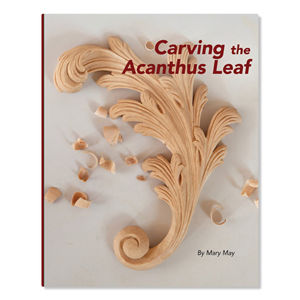
and shoulders above the rest. Mary May's
Carving the Acanthus Leaf
is such a book.
Mary May is a highly accomplished woodcarver who carves commissioned pieces of
extraordinary quality in her modest Charleston, South Carolina, workshop. Perhaps it
was her unusual childhood in a wanderlust and encouraging family that spurred her to
apprentice for years in a series of European woodcarving shops. There she honed her
talents and deepened her resolve to adopt carving as her life's work.
Her book is a fascinating mixture of artistry and design, carving technique and personal
stories about her life as a carver. The foreword tells much of her life story, the
development of her inquisitiveness and how she first became interested, then trained in
carving.
Then it's on to the acanthus leaf. A common plant in southern Europe, the acanthus is
almost regarded as an invasive species there, though its spiny leaves are sometimes
cultivated for ornamental purposes in the U.S. and elsewhere. Chapter 1 traces the
history of the acanthus leaf as a design element from its early Greek origins to the
present time.
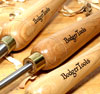
Chapter 2 gives an overview of the carver's tools and how they're used. She urges
buying the best gouges you can afford, since properly cared for they'll last more than a
lifetime. They're used two-handed, one hand on the handle for propulsion, the other on
the shank to guide and restrain the power applied to the handle. Mary prefers long-handled gouges and favors European models. For a mallet, she chooses a 1 lb. or 1-1/2
lb. mallet with a brass or steel head. She recommends basswood or butternut when
starting to carve because they are softer and have forgiving grain. Once skills have
been developed, other woods such as mahogany, walnut, cherry and oak are good
subjects.
Some power tools are helpful aids to carving. Mary has a scroll saw and finds that a
bandsaw or coping saw are helpful for shaping larger pieces. The standing position
works best, with the bench 1-2 inches below the elbows. She offers some tips: cut
away from yourself for safety; secure the wood to a backing board with the grain
running left and right; learn to carve using both hands to propel and guide the gouge;
pay attention to grain direction and use slicing cuts. She explains several methods for
transferring patterns to workpieces. And perhaps most importantly, she describes how
she sharpens her gouges to keep them in prime cutting condition.
Chapter 3 offers an introduction to the acanthus leaf as it is carved. She emphasizes
the importance of drawing the leaf before carving it, perhaps doing it many times until
you get to the point that you can draw it freehand. This is a valuable skill that will pay
dividends when you later begin to carve.
You will need to learn the terminology of the acanthus leaf—midrib, primary and
secondary lobes, eyes, serrations, primary and secondary veins, pipes and wrinkle
cuts—and Mary provides instruction.
In Chapter 4 she shows how to draw and carve the first of 13 examples of acanthus
leaves. The basic acanthus leaf is symmetrical without complex curves or shapes,
though it has some of the details that are incorporated in more complex designs
encountered later in the book. As she does in each chapter, Mary gives step-by-step
guidance on first drawing, then carving this example.
Chapter 5 presents the basic acanthus leaf with a twist, literally. In this example, the
mid ribs are an S-curve rather than straight. This style, which originated in Italy, has
been around from Roman times to the present. Chapter 6 teaches carving acanthus
leaves as repeated patterns on a moulding.
As the book progresses, so does the intricacy and difficulty of the projects. The next
chapter demonstrates a rosette. A design feature since the Roman Empire, rosettes
can be round or oval, square or rectangular. Square or round rosettes are carved
symmetrically with the four primary lobes evenly positioned, so the blank can be
prepared on a lathe.
Furnituremakers will especially appreciate Chapter 8, which teaches carving acanthus
leaves on cabriole legs. Though fashionable before Thomas Chippendale began to
employ them, they nonetheless are closely associated with the style that bear his name.
The acanthus leaves are typically carved on the knees, with feet that are ball and claw
or trifid. This form was common in the mid to late 18th century, with reproductions
occurring throughout the 19th century.
Acanthus leaves can also be incorporated in turnings, as Chapter 9 demonstrates.
Examples are bed posts, lamps and table legs. Another application is on brackets used
for architectural supports or corbels employed decoratively in conjunction with windows,
fireplace mantels, beams and shelves, among other places.
An Italian Renaissance leaf comes next. Originating in Italy, it was most often
associated with the Renaissance and Baroque periods. It incorporates a graceful S-shaped body that can then be complete in itself, repeated along a frieze or sometimes
intertwined with other leaves. The succeeding chapter takes the Italian Renaissance
leaf one step further by adding small curling extensions.
Scandinavian-style leaves are simpler in effect, formed as C-curves that often continue
into S-curves, with smaller leaflets that flow from the main leaves. In this interpretation,
the carvings are crisp, smooth and graceful, with eyes and pipes generally omitted.
The Greek acanthus leaf has similarities to the later Roman and Byzantine styles. It
features multiple V shapes that radiate out from the base toward sharply-pointed tips.
The French Rococo leaf from 18th century France, lighter and more imaginative than the
bold and dramatic Baroque design, employs asymmetrical C and S-curves.
The final example is a Baroque leaf, a repeated and expandable scrolling design of
leaves and veins in bold style. This design has roots in ancient Greece and has
survived because of its versatility and durability.
Several features make this a very special book. It is impeccably written. It is superbly
illustrated with step-by-step drawings of each phase of the drawing process for each
project and with full color photographs of each step of the carving process. It gives brief
histories of the many variations of the acanthus leaf. It includes photographs of real-life
examples of the acanthus leaf on furniture and in architectural applications. And
charming human-interest interludes about Mary and her carving life are inserted
between chapters, a feature I found utterly delightful.
The book, published by the redoubtable
Lost Art Press
, is cloth bound with a separate
full-color slip cover.
In my opinion, this is a book not merely to own but to treasure. Woodcarvers will
certainly want their own copies, as will cabinetmakers with a special interest in period
furniture. So too architects, designers, furniture historians and anyone with an eye for
beauty in design. I highly recommend it.
Find out more and purchase
Carving the Acanthus Leaf
by Mary May
J. Norman Reid is a woodworker, writer, and woodworking instructor living in the Blue Ridge Mountains with his wife, a woodshop full of power and hand tools and four cats who think they are cabinetmaker's assistants. He is the author of
Choosing and Using Handplanes
.
He can be reached by email at
nreid@fcc.net
.
Return to Wood News Online
|