|
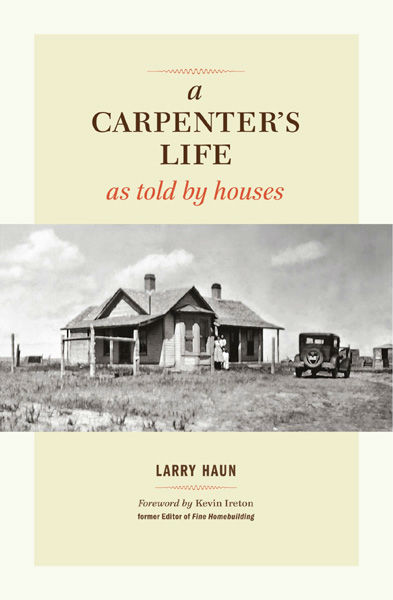
This charming book,
A Carpenter's Life As Told By Houses
, is not your ordinary woodworking book. It addresses not
cabinetmaking, but carpentry and the home construction trades. And rather than
serving as a "how to" guide, it is instead a biographical account of the life of a carpenter
and sometimes writer whose life experiences encompassed a wide variety of housing
types, ten of which are featured here. At the same time, the book serves as the
author's manifesto on the preciousness of Mother Earth and the possibility of living in
closer harmony with it. Throughout, Haun makes observations about the way of life he
and his family experienced during the Depression and post-War period on the plains of
western Nebraska.
The book progresses chronologically through the sequence of houses he lived in and
built during his long career. For each house, he makes observations about construction
methods that are sufficient to comprehend but generally not enough to replicate them.
At the same time, he observes what life was like while living in each of the houses, then
paints a portrait of life on the prairie and in other places where he resided.
The first house, and one he never lived in, was the iconic structure of the prairie, the
soddy. His mother was born and raised in a soddy and Haun worked on one as a
young man. He describes in general terms how they were built and relates
observations on the place of the soddy in prairie social and cultural life in the 1800s and
early 1900s. Not only were soddies built of the only materials readily obtainable on the
treeless plains, but they also afforded warmth against the cold northern winds and sub-freezing winter temperatures in that unforgiving clime. While he does not wish to return
to those "good old days," he nevertheless yearns for the communion with nature the
soddy represented.
Next is the straw bale house, which, he notes, is making a revival in some places. A
straw bale house has several advantages: low cost, insulating capacity, freedom from
noxious fumes, and the opportunity for artistic creativity in design. His mother taught
school in a straw bale house and Haun himself helped to build one and later slept in it
for a time. Straw bale houses were a better solution in Nebraska's Sand Hills, where
there are no trees and soddies often failed because the sand won't hold the roots of
grasses needed to form sod. When horse-powered hay presses were introduced in the late 1800s, straw bale houses became feasible and began to replace soddies. They
were not built to last, however, and few survive today.
Haun was born in what he calls an "old frame house." It had, he recalls, a shake cedar
roof and walls with no insulation. Nor were there electric power or plumbing. Times
were hard during the Depression. He describes how drifts of snow would blow through
the keyhole overnight and the preventive steps needed to ward off penetrating dust
during the dust storms that blew in that decade. These frame houses were built in the
traditional way using hand tools and wood hauled in from a long distance away. There
was little waste in building these houses, which leads him to decry the massive waste
generated by modern American society.
Another prototypical prairie house was the dugout, and he often visited one until he was
in his late teens. Because of the constant wind on the prairie, the dugout, sheltered as
it was, suited better than the soddies. Nevertheless, people who lived in them were
looked down upon. Haun's childhood friends lived in a dugout and he reflects
nostalgically about the days before they moved away.
Precut houses were a more recent innovation. He discusses helping to build one, with
a hand-dug cellar. It was sheathed in tarpaper and covered with asbestos shingles.
Living as he did just south of the Sioux Pine Ridge Reservation, he was affected by the
plight of the Sioux and laments their treatment.
For a time after leaving Nebraska, he lived in his brother's adobe house in Albuquerque
and later helped to build one. Their organic structure is composed of a sustainable
material. Because adobe buildings don't need to conform to rectangular shapes, they
can reflect innovative designs. They can be made inexpensively by hand or by using a
machine that can turn out thousands of bricks daily. The adobe's thick walls cool by
absorbing heat during the day, then radiate warmth during the cool nights.
Cob houses are like adobes, except that they employ wet mud instead of dried bricks.
Their outsides are usually plastered with lime, which offers protection while allowing the
walls to breathe. The roofs of cob houses are often rounded and made by using the
natural curve of branches, a more beautiful look, but one that's more difficult to build
than by 2X construction.
In 1950, Haun moved to Los Angeles and at first lived in a teardrop trailer. He worked
for $1 a day building houses with hand tools, saving his money to go to college. He
began working on housing by building a modular home for his parents, a military surplus
home shipped in sections, assembled on site, and featuring a hand-dug cellar.
The Quonset hut was a World War II staple that was prefabricated and easy to erect.
During the Korean War, Haun served with the Seabees and lived for a time in a Quonset hut, then served in Greenland where he helped assemble an experimental hut
on the ice cap.
Tract houses started in the post-War period, when large numbers of houses were
needed for returning War veterans. To meet the heavy demand, the construction
industry had to change. Power tools began to replace hand tools, plywood became
more common, precut construction materials came into use, and specialization and
modular construction replaced general carpentry.
Later in life, Haun became involved with the Habitat for Humanity. Habitat houses are
superior in some ways, by being built carefully and sustainably and by eliminating toxic
materials. His joy in participating in Habitat builds came not as much from helping
others, he says, as in helping himself to be whole.
He next describes his "small house," where he has lived for years. He never lived in a
house with more than 1200 square feet of space. He finds the small house to be less
expensive, easier to clean, and cheaper to heat and cool. His home was built "green,"
which he argues is more than just checking boxes on a list of criteria, but that requires
attention to design.
The final structure is the greenhouse he built using salvaged materials costing less than
$100. A gardener for much of his life, he was successful in supplementing his income
by selling vegetables at the local farmer's market.
This delightful book is filled with many nostalgic observations and interesting stories
about both home construction and memories of his life in connection with each of them.
You won't find cabinetmaking here or even a thorough introduction to carpentry. But
you will find an enticing read. The hardback, slip covered book contains many black
and white photos that add greatly to its interest. Woodworkers will enjoy a trip down
memory lane, but the book will interest a wider audience including anyone with an
interest in the range of housing in America. I liked this book as a diversion from the
usual woodworking fare and a pleasant walk through the history of housing during the
last century.
Find out more and purchase
A Carpenter's Life As Told By Houses
by Larry Haun
J. Norman Reid is a woodworker, writer, and woodworking instructor living in the Blue Ridge Mountains with his wife, a woodshop full of power and hand tools and four cats who think they are cabinetmaker's assistants. He is the author of
Choosing and Using Handplanes
. He can be reached by email at
nreid@fcc.net
.
Return to Wood News Online
|