|
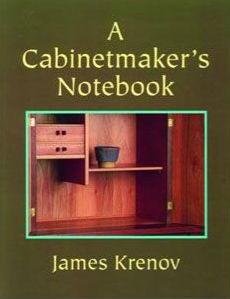
A Cabinetmakers Notebook
, the first of several books by the legendary James Krenov, has long been a classic. It's held a place on my woodworking bookshelf for far too long, where it languished unread. Finally, I had an opportunity to pick it up. I'm quite glad I did.
This is a wonderfully reflective book. It offers an opportunity to get inside the thinking of
a man who was an exemplary artist and craftsman and a deeply individual woodworker.
The book itself is not highly structured. Instead, it proceeds as a set of musings that
move from one theme to the next in an almost stream of consciousness fashion. And
yet, the text is by no means formless or random, but it lays out his approach to
woodworking and, as it were, his philosophy about the craft in a clear and convincing
way.
And what is that philosophy, the viewpoint he held about working with wood?
Fundamentally, it was that wood is a living medium and something with which he had a
lifelong love affair. This was revealed in his careful haunting of lumber yards in search
of special pieces of wood, and the fact that he lived with his planks for years until they
whispered to him how they wanted to be used. He eschewed kiln dried lumber in favor
of air-dried boards, noting that kiln drying kills the wood and destroys its individuality of
color in order to yield commercially desired uniformity.
His practice was to create without plans, and he seldom made drawings, usually
abandoning them in the execution of the pieces when he did. Instead, he built his
creations on the fly, consulting the qualities of the lumber for its best use, then testing,
re-examining, and allowing his creations to evolve into what they would become. It is for
this reason that he seldom took commissions, preferring instead to allow his creations to
emerge as harmonious pieces that were both beautiful to the eye and that met the
functional purposes of the pieces in use.
Underlying all his efforts was the expectation of exemplary craftsmanship, of an
approach to perfection in execution. For this reason, he chose to work alone, so he
could be certain of maintaining the quality of his output. It was his practice to begin his iconic cabinets with the doors and drawers, since these were often the most difficult
parts to craft and the parts around which the resulting designs would revolve. Then he
proceeded to build from the inside out. That way, should something go wrong with the
initial parts, he could abandon a project before he had invested himself too deeply in it.
He used powered machines for breaking down the heavy timbers from which he worked
but was happiest when he could apply his beloved hand tools, especially his wood
bodied planes, to shaping the curves that characterized much of his work and
smoothing the final surfaces, which he often left without a finish. In addition to revealing
his perspective on cabinetmaking, Krenov presented examples of some of his work. The
mostly black and white photographs show the details of his work, the joinery, the
smooth curves, the tiny elements such as pulls that refined his creations. A color center
section complements these B&W photographs.
The book contains a very interesting autobiographical sketch. Russian born, he was
reared in Alaska and Seattle but did his early work in Sweden, where jobs were plentiful
after World War II. After choosing a life in woodworking, he returned to the US to
establish himself as a solitary craftsman. The account does not extend to his teaching
years at the College of the Redwoods, for which he later became famous.
This is a book that merits savoring. It is, at one level, an introduction to the man and his
important voice in woodworking. At another, it's an appeal to treat wood with deep
respect and to adopt a contemplative approach to working the medium, resisting the
temptation to rush projects or yield to the pressures of economic competition.
The book will have broad appeal. Armchair woodworkers will find it a very refreshing
dive into an individual way of working wood and the life of a truly interesting man.
Woodworkers with a historic bent will find themselves attracted by this intriguingly
distinctive personality. Hand tool aficionados will find inspiration to excel at their
approach to woodworking. And any woodworker seeking the path of excellence in
craftsmanship will be stimulated to bring a higher standard to their work.
I'm glad I finally drew this slender volume from its dust coated shelf. My only regret is
that I did not do so much sooner than I did.
Find out more and purchase
A Cabinetmakers Notebook
at Highland Woodworking
J. Norman Reid is a woodworker, writer, and woodworking instructor living in the Blue Ridge Mountains with his wife, a woodshop full of power and hand tools and four cats who think they are cabinetmaker's assistants. He is the author of
Choosing and Using Handplanes
. He can be reached by email at
nreid@fcc.net
.
Return to Wood News Online
|