|
Perhaps you're looking for ideas about small things you can build as gifts. Or, you may
have your eye on selling in the craft market or at local gift stores. Like many of us, you
may have an abundance of leftover scraps just too good to burn but too small for
furniture. Or, maybe you're simply looking for fresh challenges to take on in your shop.
Whatever your motive, building boxes may be a great way to meet your needs.
If so, a good book or two on box building may be just the thing to fill your idea
tank or introduce you to construction methods you might not have thought about.
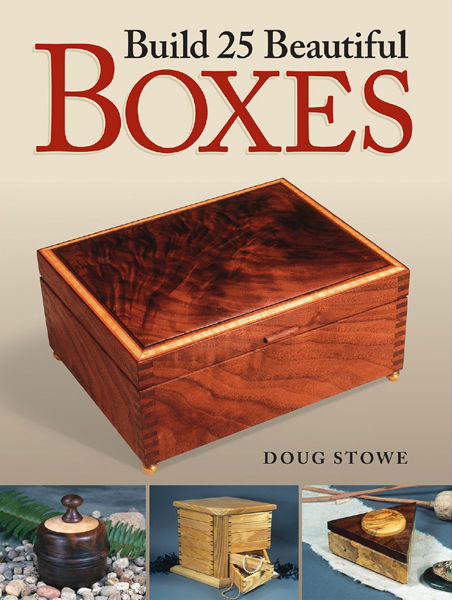
Build 25 Beautiful Boxes
by Doug Stowe is such a book. It's filled with novel designs and fresh inspiration
that will give you models to emulate and that will stimulate further exploration of your
own conceptions.
Rather than being a step-by-step introduction to box building, something that Stowe has
provided in his other books
, this book dives right into the construction of 25 boxes of
diverse and innovative design. As he does, Stowe tackles specific issues when he
encounters them, so that when the book is read as a whole, it makes up a fairly
complete resource in addition to its primary function as a stock of ideas not presented
elsewhere.
Stowe's own practice is to use domestic hardwoods in his work, including some like
sassafras that are often overlooked. Much of his stock comes from reclaimed wood he
has chain sawed into lumber and air dried in an abandoned greenhouse. Much of this
wood is spalted, giving it the unique and unusual grain patterns and colors that make
his creations special. But he also employs offcuts from larger projects in his creations.
Many of his boxes are decorated with shopmade veneer, and he opens the book with
an enticing introduction to his method for making veneer in a variety of patterns. Though
his discussion leaves room for further exploration, it gives sufficient guidance to get you
started with simple designs that will enhance the appearance of many styles of boxes.
Stowe employs several types of joinery in his boxes. His earliest boxes used butt joints
to attach the ends to the sides, and he still uses this method on some of the smaller
boxes. Other methods he illustrates are mitered corners reinforced with keys or, as he calls them, slip feathers. Still others are constructed with hand cut dovetails, or with
finger or box joints. And on several boxes, he uses mortise and tenon joints to provide a
secure attachment to what otherwise appears to be a butt joint.
The 25 boxes span a wide range in both size and complexity of construction. They
come in a surprising array of shapes, including the expected rectangular boxes but also
round, half round, and triangular boxes, as well as tall boxes with drawers. They
represent a number of types and purposes, including pen boxes, ring boxes, bracelet
boxes, a tea caddy, jewelry chest, chest of drawers, music box, and even a reliquary.
Some of the boxes are Stowe's primary production boxes for sale, while others are one-time designs he made as gifts.
Many of his boxes incorporate drawers, including secret drawers on several of the
designs. Others, such as the tea caddy, involve the construction of interior dividers. The
boxes use a number of methods to attach their lids, including barrel hinges, mortised
hinges, and a 3/16 inch brass welding rod. Stowe describes each of the methods as he
uses them in building the boxes that employ them.
Stowe's boxes incorporate numerous design details, including pulls of different types,
feet, and decorative details such as edge banding, and when these are encountered,
Stowe walks us through his method for accomplishing them.
Stowe uses numerous jigs and fixtures to guide his router, which is extensively used in
building these boxes, and the text describes how to make and use them to assure
accurate and repeatable results.
With so many small parts being used in crafting boxes, safety is a primary concern, and
Stowe devotes attention to how to complete the needed operations with due concern for
the security of your irreplaceable fingers.
Sprinkled throughout the book are observations on the sources of the wood he uses, in
one case reclaimed from a replaced kitchen countertop. His musings give the book a
personable feel that makes box building seem more approachable.
The book concludes with an interesting essay on Stowe's perspective on creativity and
his practice of mindfulness while he is designing and crafting boxes and other
woodworking projects.
I found this book to be an exciting addendum to other box-building books in my
collection. If this is your first foray into box building, you may want to begin with another,
more basic manual such as
one of Stowe's other books
. This book serves best as an
idea book for both design and techniques and will stretch your thinking beyond the basic
material found elsewhere. I like several of the designs in this book and will be building boxes using Stowe's ideas as a starting point, but I'll be modifying the size, species of
wood, and design elements to fit my own personal concept. If, like me, you are looking for
new ideas for design and construction techniques, you'll find this a delightful and helpful resource.
Find out more and purchase
Build 25 Beautiful Boxes
at Highland Woodworking
J. Norman Reid is a woodworker, writer, and woodworking instructor living in the Blue Ridge Mountains with his wife, a woodshop full of power and hand tools and four cats who think they are cabinetmaker's assistants. He is the author of
Choosing and Using Handplanes
. He can be reached by email at
nreid@fcc.net
.
Return to Wood News Online
|