|
Click on any picture to see a larger version.
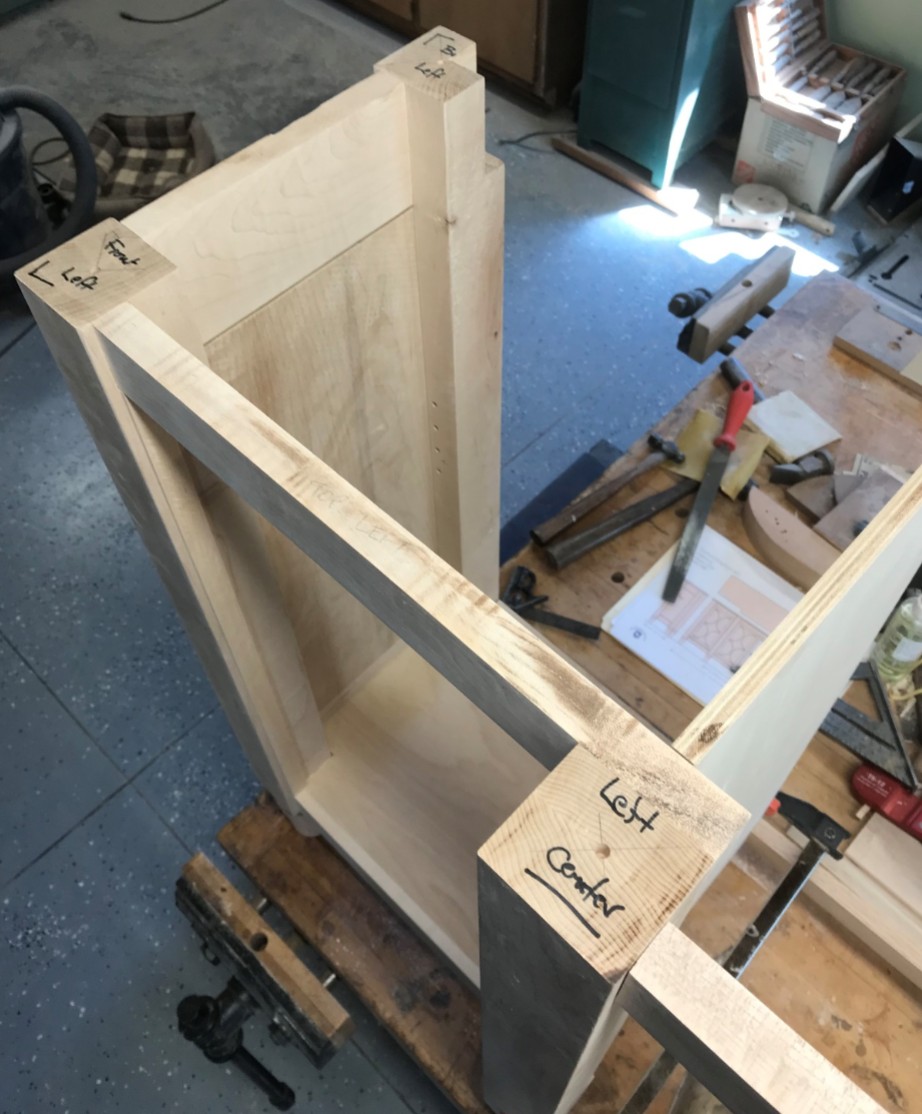
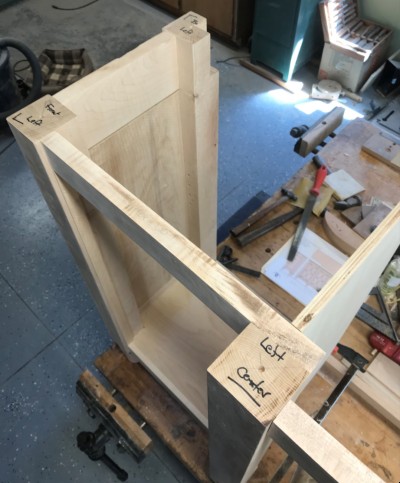
This month, I have been working on a pair of dining room cabinets. The sideboard is a fairly complex
carcase with 6 legs and a bumped-out center section. The rear legs each have two pockets, two
mortises, a rabbet, a slot, and a set of shelf pin holes. There are three legs on the left side of the carcase
and their mirror-image sisters on the right. To avoid errors I am marking parts and checking twice before
cutting. I can feel my brain working overtime on this one as I picture the pieces fitting together in my
head. Woodworking involves skills like measurement and tool use, but it also draws on something called
cognitive spatial ability.
|
|
Figure 1. Labeled parts - nobody needs 2 left legs.
|
Spatial Intelligence is defined as the cognitive ability to form mental models or images and to
manipulate them through time and space in your mind. It is what you use when you read a map and
think about your route to the lumberyard. Or when you consider whether you need a larger bag to hold
the things you bought
on sale at Highland
. Along with other cognitive skills like verbal ability and
analytical reasoning, spatial ability is one distinct part of how our brains process information. Research
shows that children develop spatial concepts and processing through physical interaction with the world
around them.
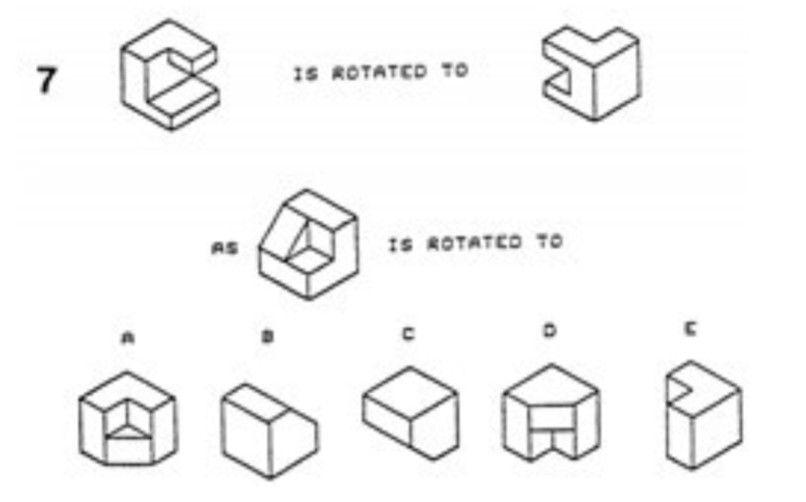
Spatial ability is measurable, and everyone has different levels of ability. Most spatial ability tests
present a picture of something and then ask you to match it to an image that has been rotated or
transformed or reflected in some way. Here's an example from the
Purdue Visualization of Rotations Test
(the correct answer is "b").
Teachers measure spatial ability as part of assessments of early learning. Employers like to
measure spatial ability
since it can predict job performance in technical fields like engineering, architecture, medicine, chemistry, and even
woodworking
!
While I grew up playing with Tinker Toys, Erector Sets and blocks (all good spatial training), my
formal education in spatial skills really came in junior high shop class. Mr. Westphal taught the first shop
course, Mechanical Drawing, in 7th grade. We learned how to write block letters and use triangles and T-squares. However the key skill development was how to visualize objects. Mr. Westphal would put an
object (usually an odd-shaped block with various holes and notches) on the table and we would have to
draw the front, side, and top projections (orthographic views) with dotted lines showing hidden details
in each view. Later we learned how to draft isometric views and perspective views. Can you picture the
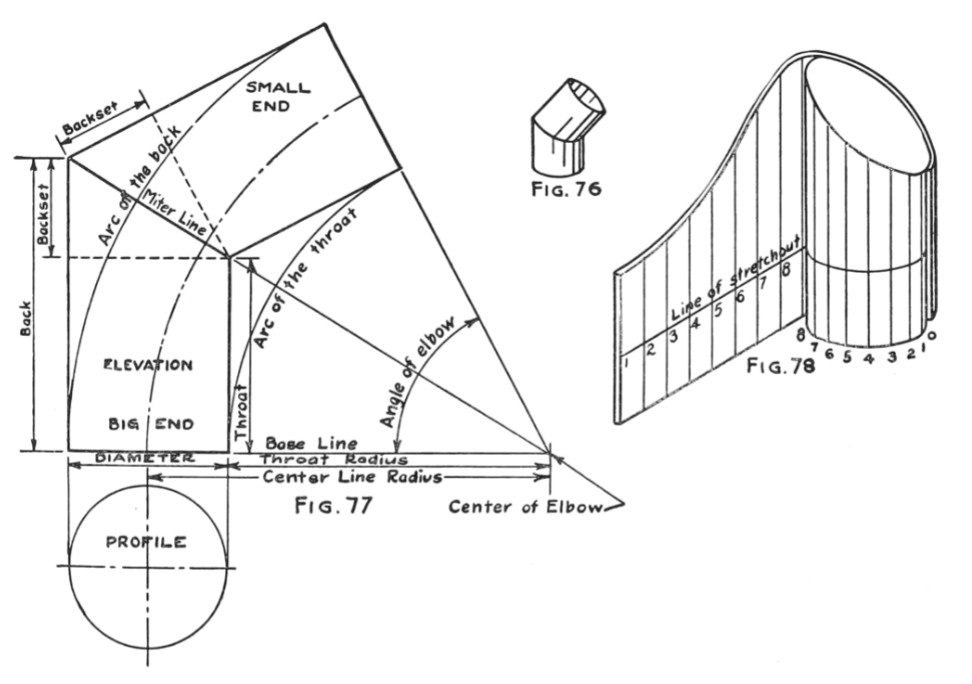
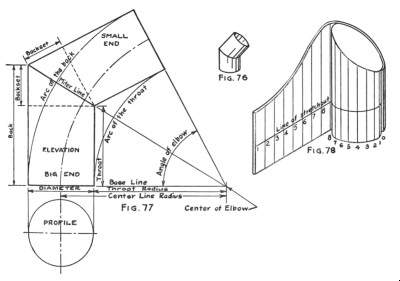
backside of an object in your head? By the time we got to Metal Shop in 9th grade we were able to layout
duct elbows on flat sheet metal, a spatial skill called "folding."
|
|
Figure 3. 2D to 3D translation for a sheet metal elbow.
|
Shop was an elective course, and I am glad I chose to take it. It was fun but more importantly it was
critical training in how to think visually. Now, in my day-to-day woodworking I draw on spatial skills all
the time. For example:
Joinery
. When you layout a dovetail and match up the angles of the pins and tails you are using spatial reasoning. Try making a dovetail on a compound miter corner and feel your spatial reasoning
neurons really stretch!
Moving Parts
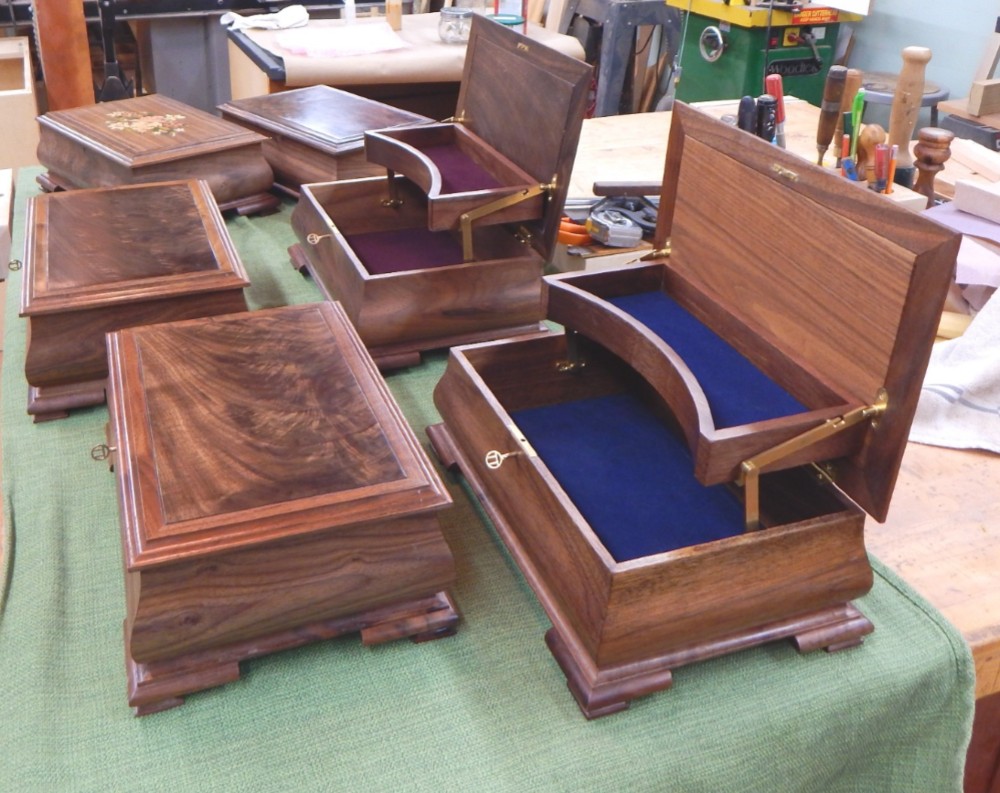
. Drawers and doors can pose interesting spatial challenges. Is that corner block in the back
of the cabinet going to keep the drawer from going in all the way? Will your cabinet doors be able to
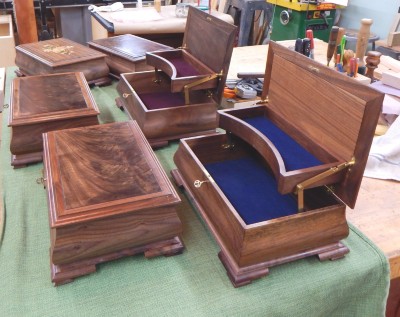
open past 90° before they hit the corner leg? I have spent hours on a project working out the motions
and clearances for a rising tray jewelry box. If you can't see inside the box with your eyes you have to be
able to see inside with your mind.
|
Figure 4 - Jewelry boxes with rising tray hardware.
How does that really work?
|
Grain Orientation
. Another mental model of moving parts is when you think about wood movement and
grain orientation. We all know that wood movement is greater across the grain than with the grain.
When you look at your project and anticipate where you need to make allowances for wood expansion
you are using spatial reasoning.
Order of Operations
. As you plan how your project will proceed you are likely processing a mental image
through time. If I am making a box for example, I might first picture the sides laid out flat with miter
corners and a groove for the bottom panel. Then I can imagine the assembly of the bottom panel into
the groove and the sides wrapped around the panel with painter's tape holding it all together. When
you mentally walk through an assembly process you can see things like where to pre-finish parts or
which parts to glue first.
There are many research studies showing that spatial ability is trainable. Like almost any other human
skill, spatial ability responds to practice and exercise. Games like Chess, jigsaw puzzles, or Tetris have
been shown to enhance spatial performance. The most effective training appears to be hands-on
activities where you are actually manipulating objects. Make your own
wooden puzzles
and get double
the training benefit! Consider
practicing joinery
by making some sample joints. Try something
challenging like a blind dovetail or a
3-way locking miter
. Another proven way to enhance your spatial
skills is to pick up a pencil and start drawing. Mr. Westphal knew what he was doing back in 7th grade. In
their book,
By Hand and Eye
, Walker and Tolpin call this "waking up your eye." Sketching is a hands-on
activity that connects your eyes, hands, and spatial processing networks. In your brain, all those
neurological connections get used and reinforced leading to better spatial ability.
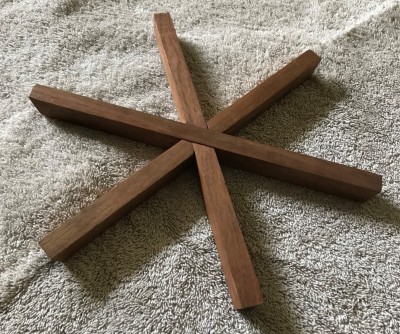
|
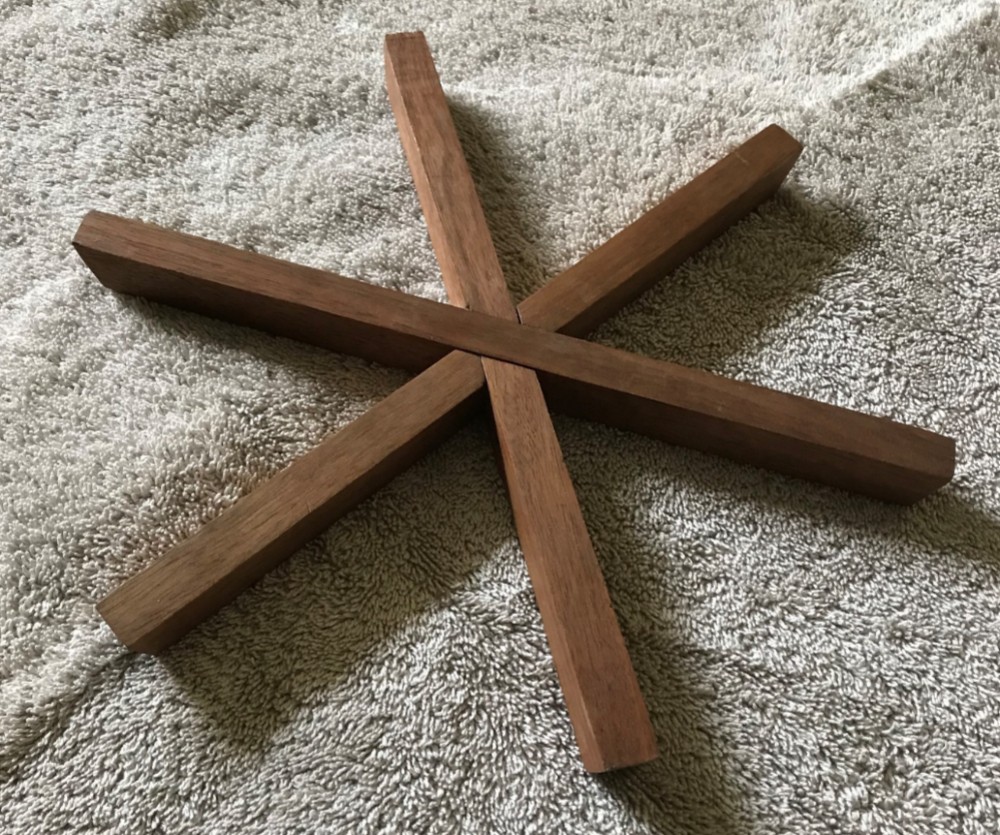
Figure 4 - A 3-way lap joint in a walnut trivet.
Can you picture what the middle piece looks like?
|
Sketching, doing puzzles, and folding Origami, are all techniques that help develop spatial skills. With good
spatial skills you can work efficiently from plans in the magazine. However, the ultimate spatial
intelligence comes when you think visually, when your spatial skills help you imagine something that has
never been made before.
When someone wants a custom piece of furniture we have a conversation about their ideas, maybe we
look at some pictures of different things they like. But then, in my mind, there's that moment of
conception. I can see what I am going to make. The vision comes first. I can't start drawing it until I have
the picture in my head. I can't start cutting wood until I have the picture in my head. Funny how
woodworking in your head has no sawdust, no chip-out in the grain, and the gap around the drawers is
always perfectly even and tight. Visions, created through some miracle of neural activity, set the
standard for excellence. This is what it is supposed to look like, how it is supposed to function.
Michelangelo, the famous sculptor, supposedly said, "I saw the angel in the marble, and I carved until I
set him free." Grandpa Rummer once had a vision of a beautiful walnut cradle that could be handed down
through the family. In his mind's eye he saw perfect joinery and flawless finish while great-grandchildren
he would never meet rocked gently to sleep. He employed his woodworking skills to create the thing
that he could picture in his mind, to set the angel free. Why should you hone your spatial abilities as well
as your chisels? Because the joy of woodworking is found when our visions are unbounded and our skills
are competent and capable.
References
Cuendet, S., Dehler-Zufferey, J., Arn, C. et al. A study of carpenter apprentices' spatial skills. Empirical Res Voc Ed Train 6, 3 (2014).
https://ervet-journal.springeropen.com/articles/10.1186/s40461-014-0003-3
.
Walker, G and Tolpin, J. 2013.
By Hand and Eye
. Lost Art Press. 186 p.
Bob Rummer lives in Colorado and is a part-time woodworker. He can be reached directly via email at
rummersohne@gmail.com
. You can see his shop and some of his work at
www.JRummerSons.com
.
Return to the
Wood News Online
front page
|