|
Click on any picture to see a larger version.
The auger bit, used with a hand brace, was the primary means to drill a hole prior to the
introduction of power tools. You don't see them very often today unless you are a serious hand tool
woodworker but for certain applications, they may be better than using a modern twist bit and power
drill. I'll get into that in a minute but first let me discuss the basics of auger bits. At first glance all
auger bits may look the same but there are actually a variety of patterns of bits.
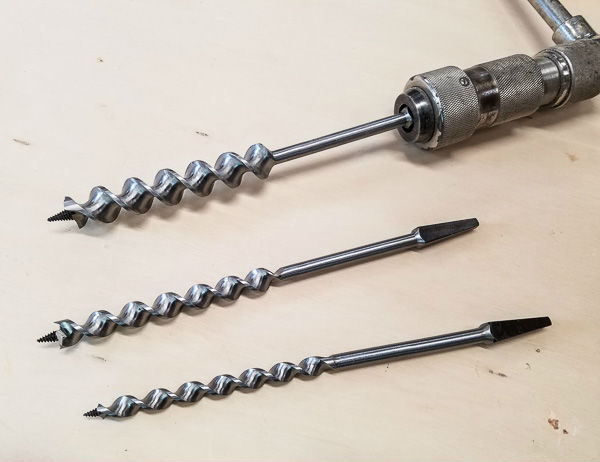
The
Fisch Jennings Pattern Auger Bit
has a square tapered shank that is inserted into the chuck on the
bottom of a brace. The brace can have different width handles to provide more or less 'swing' to the
drill. You might want to use a bigger swing if you are using a larger size bit or going deep into the
wood. Auger bits, like the modern bits, come in a variety of sizes.
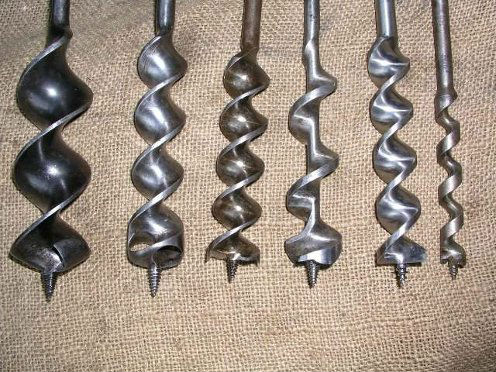
Auger bits also come in a variety of 'patterns' or shapes. Below is a picture of six different
types, from left to right: Gedge, solid nose or bull nose, Russell Jennings, solid center or Irwin, scotch
pattern and L'Hommedieu pattern. The most noticeable difference is the double twist of the Jennings,
the solid center core of the Irwin and the empty center of the L'Hommedieu.
The Russell Jennings pattern, which is used by Fisch, is the third from the left. The most
common types you will see for sale in stores and in flea markets are the Jennings, solid center or Irwin
and the L'Hommedieu pattern. This review is not a discussion of the various types of auger bits but
let me just say that each provides their own unique way of scoring the wood upon entry into the
surface of the board and how easily they eject chips from the hole during drilling.
The Russell Jennings auger is the most common pattern for auger bits and is widely seen as
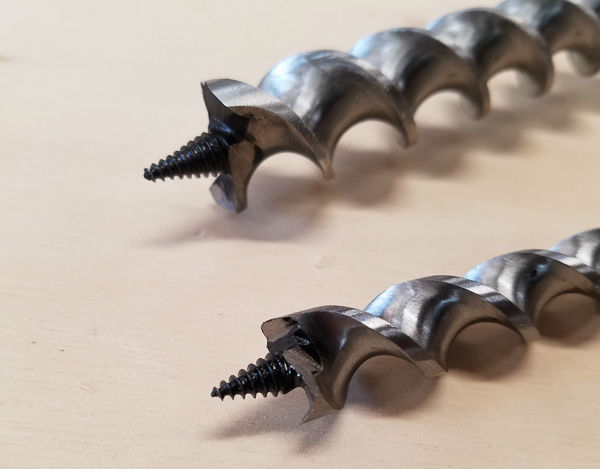
'standard' for auger bit design. It features flat lips, and spurs that protrude from the bottom of the
bit. The Russell Jennings augers are also double-twisted so the bit bores a neat hole. The large, open
flute of the Jennings bit facilitates rapid and easy clearance of chips. The spurs, which point in the same
direction as the guide screw, scores the wood and creates a clean hole. The guide screw pulls the bit
through the wood.
The Fisch brand
is known for high-quality drill bits for power tool operations. These auger bits
appear to have the same level of quality as they put into their power drill bits. They are made in
Austria and come in the following sizes: 1/4", 5/16", 3/8", 1/2", 9/16", 5/8", 3/4", 7/8", and 1".
So, why use an auger bit? If you are a hand tool purist you will want a set of auger bits for your
drilling needs. If you need a smaller hole size than a 1/4" you can turn to an 'egg-beater' drill but
nothing beats an auger bit for larger size holes. The auger bit really shines when you need to drill a
large angled hole in your piece of wood. For example, the auger bit is excellent for drilling the angled
hole (mortise) in a chair seat to receive the tenon of a chair leg. The angled hole is easy to start
because of the lead screw.
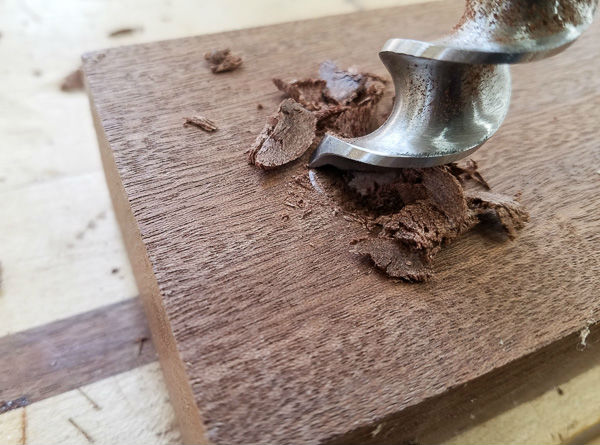
The spurs on the leading edges of the Jennings bit score the wood and create a clean entry
into the wood.
Since you control the speed by how fast you turn the handle on the brace, you can easily
control the angle of the bit, the first scoring cuts can be very slow and accurate and then you can
speed up to go for your depth.
The lead screw also gives you an indication when the bit is about to break through the
opposite side of the board so you can stop, remove the bit and continue from the opposite side of the
board.
This gives you a clean entry point on both surfaces of your board. I don't believe a Forstner bit
can even do this because the spur is too short.
I used a 3/4" auger bit and this technique when I was adding some extra dog holes to my work
bench a few years ago. Trying to drill a straight 3/4" hole with a Forstner bit or a large twist bit in a
drill was just not working for me but it was no problem with an auger bit.
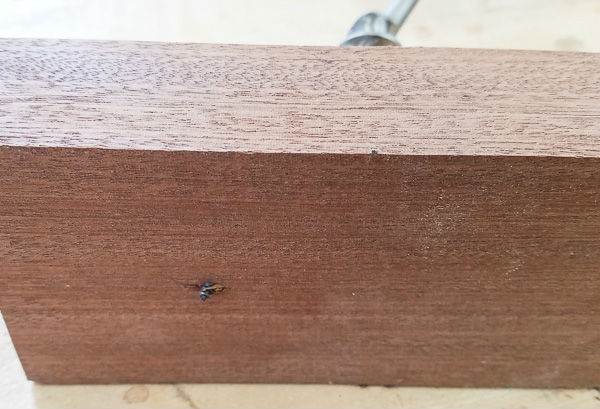
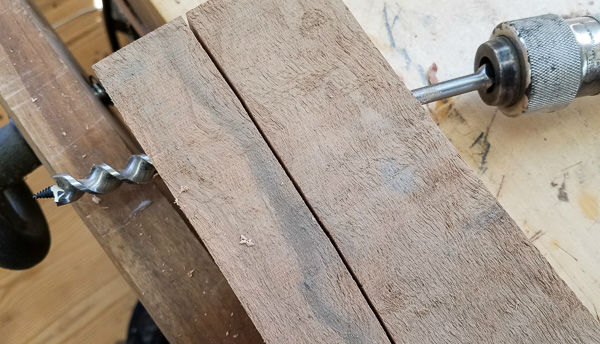
Another nice feature of auger bits is their length. They are typically longer and sturdier than
modern twist bits which makes them nice for long/deep holes. Here I've cut through a 6" wide board
(ignore the crack!).
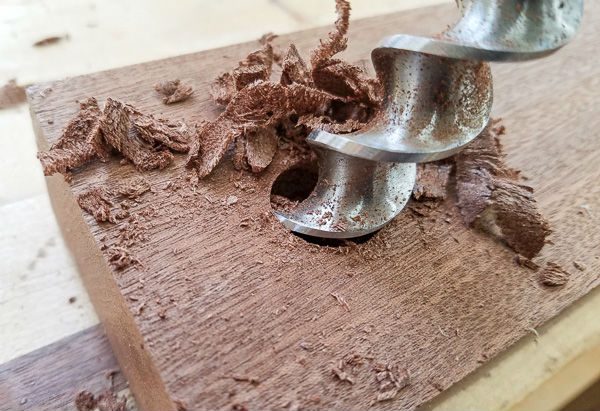
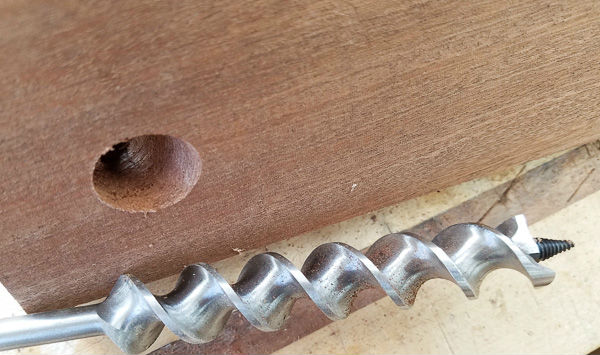
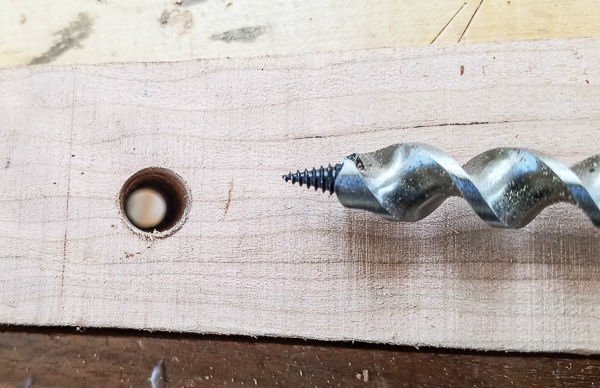
The pattern of the Jennings bit makes it ideal for ejecting the bits of cut wood so there is no
need to continually enter and back out of the hole to keep it clean like you typically do with a power
drill. Therefore, there is no chance of enlarging the hole or corrupting the entry point. Not a bad
looking hole!
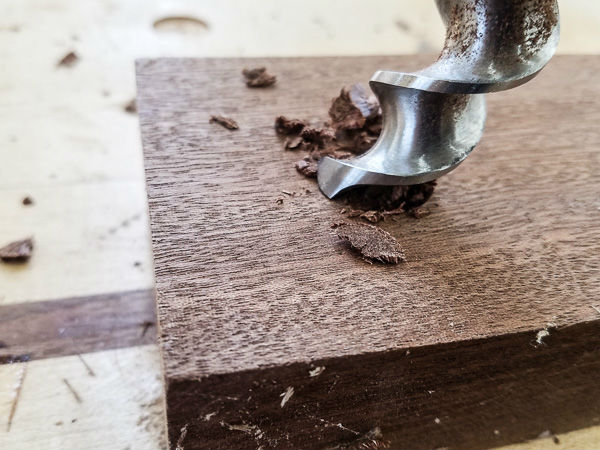
Finally, I've found that the auger bit works equally well on soft or dense woods. As briefly
mentioned earlier, the handle on a brace comes in different sizes (depths) to provide more or less power
when making your cuts. Highland Woodworking sells a
bit brace with a 10" swing
which is a 'middle of
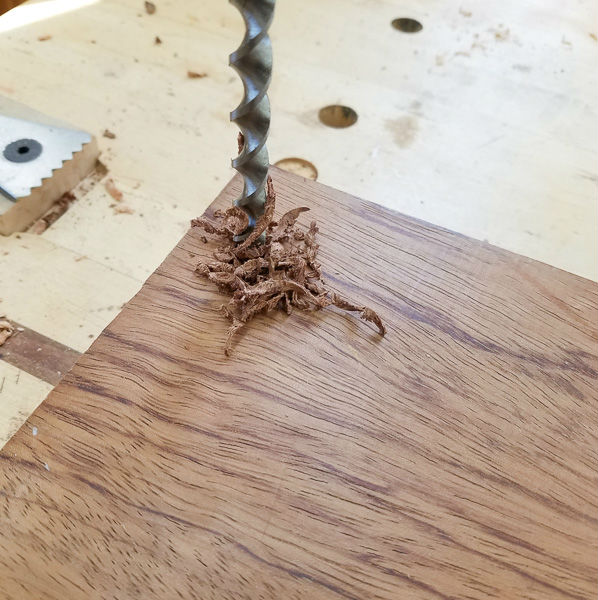
the road' size but they are available with smaller and larger swings. Below I'm drilling a hole in a piece
of bubinga with very little effort.
Again, a nice clean hole in the dense bubinga wood.
I recommend that you seriously consider adding a set of Fisch Russell Jennings auger bits and a
brace or two to your collection of woodworking tools. You never know when you will need to drill a
hole that may be hard for your power drill but is well suited for the special qualities of an auger bit.
Click here to purchase your own
Fisch Jennings Pattern Auger Bit
from Highland Woodworking.
Jeffrey Fleisher has been a woodworker for approximately 20 years and a professional woodworker for the past 6 years. He is the president of his local woodturning club, the Woodturners of the Virginias and past president of the Northern Virginia Carvers. You can see some of the furniture he has made at
www.jeffswooddesigns.com
. He can be reached by email at
furnmkr@gmail.com
Return to the
Wood News Online
front page
|