|
|
|
|
The Down to Earth Woodworker
By Steven D. Johnson
Racine, Wisconsin
|
|
Previous Page
1
2
3
Find A Lumberyard… You Probably Can (And Should)
One of the advantages of maturity… oh heck, let's not mince words… one of the advantages of old age, is the ability to see trends and changes over time. I have certainly seen the lumber business change dramatically. Home grown, locally-owned lumber yards were the norm in my youth. Almost every town of any size had a lumber yard, bigger towns had several. As I aged into my teens, some consolidation and organic expansion began to occur and some lumber yards opened or acquired multiple locations. A few years later the first multi-line lumber and hardware home improvement centers began to pop up. Anyone remember Handy Dan? Then, when I entered my mid-twenties, the first mega-big-box full-line home improvement centers began to open and everything changed. Those stores dwarfed the existing home improvement retail centers, both in size and variety of merchandise, and eventually gobbled them up through acquisition or killed them off via a starvation of business tactic. In the process, the mega-big-box stores darn near killed off the local lumberyards and hardware stores, too. The remaining stand-alone lumberyards that the three big mega-store chains didn't manage to drive out of business were then dealt a near-death blow with the 2007 recession.
This sea-change in the retail landscape seemed at the time gradual, and actually meant very little to most of us woodworkers, carpenters, remodelers, or handy-persons. In many instances the change proved to be a boon and was welcome. Yes, we missed our old lumberyards and hardware stores, but we could also go to a mega-big-box store and get lumber, insulation, pipe, drywall, electrical supplies, fasteners, and more, all in one trip. And in the early days of their growth, the major big-box retailers were keenly focused on customer service and quality products.
Of late, however, things seem to be changing. As much as I hate to point this out, the quality of products at the big-box stores is taking a decided turn downward and they have abandoned customer service as a "differentiator." In fact, these big-box retailers used to actively pursue licensed plumbers, electricians, and carpenters to staff their aisles, now they avoid these knowledgeable people. According to a store manager I spoke with, offering advice is now discouraged because that very advice turns out to often be the genesis of a lawsuit.
On the bright side, just a few miles from where I live, an abandoned lumberyard had sat shuttered and vacant, looking like a movie-set version of a ghost town for more than ten years. Now it is open again, thriving, with a dozen or so full-time employees and high quality lumber stacked to the rafters. Service is excellent and employees are knowledgeable. Their business is growing… meanwhile, the lumber I find at the big-box retailer is steadily declining in quality, seemingly getting worse by the week.
|
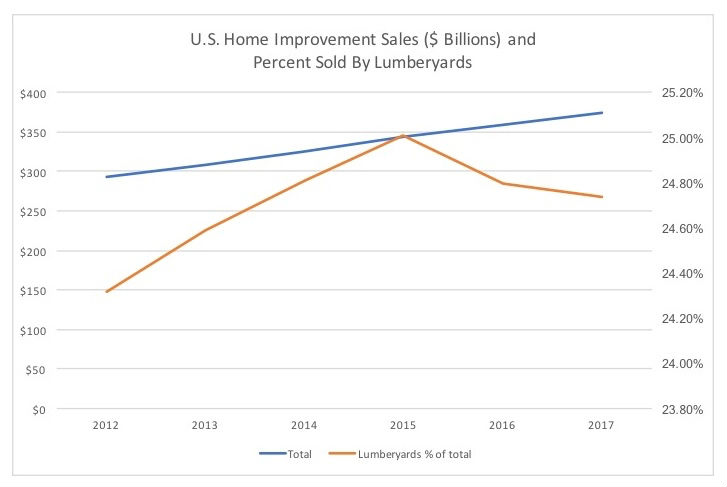
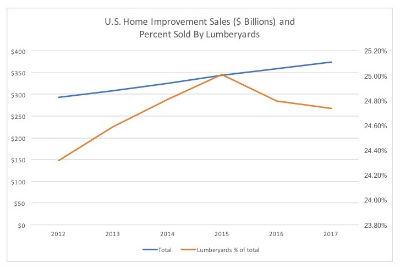
Figure 3 - Independent lumber yards poised for a comeback? Many owners and operators
think so. There was a dip in 2015, but the percentage of sales made by lumberyards has
increased amidst overall rising sales volumes.
|
And so, as I guess the business gurus would call it, a "do-consolidation" is occurring. The big box stores can leverage a "one-stop-shopping" and "price" advantage, but the independent lumberyards have a "quality" and "service" advantage. And creeping back into the midst of this fray are conventional hardware stores filling the product gap between the big-box retailers and the lumber yards.
The past is instructive, and the future will be interesting to observe, but where we stand right now is what is important, and the bottom line is that the quality of dimensional lumber, trim material, and plywood at the big box store is getting progressively worse. I suspect this is an ongoing effort to keep prices low and maintain adequate profit margins. Conversely, the quality of materials at the local lumber yard is high, but so are the prices.
It is entirely up to the individual as to where to buy lumber and plywood, but I highly recommend everyone to take a new look at local lumberyards. If you are like me, you may have fallen into the habit of going to the big-box retailer for most of your non-specialty hardwood "wood" needs, but chances are, one or more local lumber yards may be recently resurrected in your area now that our nation's economy is booming, and you may be better off paying a bit more for the service and quality of merchandise you get.
At my recently re-opened lumber yard, for example, buying is easy. I walk in to the office, give the person behind the counter my list, and he or she goes to work putting it into the computer and preparing my bill. In the meantime, I drink a little of their free coffee, wander around, shoot the breeze, and in a few minutes, I pay and am on my way to the outdoor "yard." There, a helpful employee helps me load my purchase into my truck.
I spend no time… let me reiterate… NO time, sorting through stacks of lumber to find "good" boards… they are all good. We load them right off the top of the stack, quickly. Oh, as an added benefit, those uber-annoying stapled-on price stickers are conspicuously absent on lumber yard lumber. In the big box store I have to spend considerable time sorting through a large stack of boards to find enough "usable" pieces, load them onto a cart, wheel the loaded cart to the checkout stand and wait while the clerk scans each little stapled-on tag, pay, then roll the cart out to the parking lot and transfer the boards to my truck… usually by myself and without help. The higher price of lumber yard lumber seems miniscule in light of the product quality, time and labor savings, and ease of doing business.
For me, buying dimensional lumber at the lumber yard has become a "no-brainer" decision. Sheet goods, however, presents a bit trickier decision. The difference in price between a supposedly "cabinet grade" sheet of plywood at the big box store and that sold by the lumber yard is not inconsequential. In some sizes and grades, the price difference between a 3/4" thick 4 X 8 sheet is upwards of thirty dollars. For thirty bucks, I need more than convenience and ease of doing business… I need a substantive difference in quality. You are probably going to require more justification, too, to pay those prices.
Simply looking at the show face on a sheet of plywood is not enough. Pull a sheet out and put it on a rack, cart, or table, then get eye level with the edge and look across the face. At the big box store these days you will likely see "ripples." While end-to-end and side-to-side the sheet appears to be reasonably flat, the surface has bumps and ripples, hills and valleys, that are devastating to the look of a finished project. A higher-priced alternative at the lumberyard will likely be smooth across its surface.
The other big difference can't be seen until you start to cut into the plywood, but what I now get at the lumber yard has far fewer voids, knots, or garbage amongst the cores. I once cut into a piece of big-box 3/4" ply and cut right through a foil and paper gum wrapper sandwiched between the cores. And who of us hasn't seen the occasional "spark" as we saw through a sheet of plywood. Those sparks are caused by foreign matter (dirt, tiny rocks, bits of metal, etc.) imbedded in and between the plywood cores. Less expensive so-called cabinet grade plywood has more voids in the cores, knots, foreign material, and other defects that eventually "telegraph" through to the surface, marring the overall finished look of whatever we build.
If a project calls for plywood for what will be hidden-from-view parts; for example, the sides of kitchen cabinets that will be lined up and joined together; the cheaper stuff works. If the cabinet sides will be visible, for example at the end of a run of cabinets or for free-standing pieces, I pay more and get the good stuff at the lumber yard. But this, too, is changing for me.
If I need, let's say, six sheets of 3/4" plywood, I may have to move 15 or 20 sheets at the big box store to find 6 that are acceptable. Of course, being the good guy that I am, I put the rejects back into the stack, doubling the time and work I had to do. I run a real risk of damaging the sheets each time they are handled, and at the big box store they are handled multiple times… once while sorting, again while stacking on a cart, and a third time when I put them in my truck. At the lumber yard the consistency of quality is such that sheets come directly off the stack and straight into my truck. And since everyone who gets plywood at the lumber yard is getting the same high quality, sheet after sheet, the stack of plywood hasn't been sorted and "shopped through" previously, so the edges and faces are in better shape.
Will I stop shopping at the mega-big-box store? Unlikely, at least in the near-term. When I need, as I did the other day, one sheet of drywall, three 2 X 4s, and a half-handful of nails to finish up a friend's basement laundry room project, the one-stop-shopping convenience overrides everything else. A few weeks back, a relative asked that I replace a doorknob in her house. For that singular item purchase, the locally owned franchise hardware store was an excellent choice… easy in-and-out, close, small parking lot, easy to find product, a knowledgeable employee, and a quick checkout. But when I need a larger quantity of lumber or sheet goods, and I need quality, service, and ease of purchasing, you can bet I will pay the slightly higher prices at the lumber yard.
Chances are pretty good that there is a new, or recently re-opened, lumber yard in your area. Find it. Get to know the folks there. Buy stuff. The price/convenience/quality equation is working in our favor. The tide of a rapidly improving economy is raising all boats, as the old saying goes… take advantage of it.
We are rapidly moving into full-blown woodworking season (Yay!) and it's not too early to think about gifts you might make for friends and family. I know that several people right now are building the
Cedar Garden Potting Bench project
, so be sure to check out Part 4 by
clicking here
. In Part 4 the Potting Bench tops are completed, including the tricky slotted section. Thanks for reading, thanks for watching, and thanks for being a woodworker! See you next month!
(Page 3 of 3)
Previous Page
1
2
3

Steven Johnson is retired from an almost 30-year career selling medical equipment and supplies, and now enjoys improving his shop, his skills, and his designs on a full time basis (although he says home improvement projects and furniture building have been hobbies for most of his adult life). Steven can be reached directly via email at
sjohnson@downtoearthwoodworking.com
Return to the
Wood News Online
front page
|
|
|
|
|