|
Click on any picture to see a larger version.
Saltcedar (Tamaix ramosissima), also known as Tamarisk, is a large shrub or
small tree native to the Old World. The historic range for saltcedars was the dry regions
of Eurasia and Africa - from the Mediterranean region all across Asia to China. While
here in the Unites States we often discuss saltcedar as if it were one tree, the genus
Tamarix is actually composed of 54 different species - and at least six of these now
occur in the U.S. It is not, by the way, a true cedar.
Able to tolerate extremely salty and alkaline conditions, they have become major
invasive weeds across much of the southwestern United States. Unfortunately they
were intentionally introduced to North America in the 1800s and used as ornamentals,
wind breaks, and soil stabilizers. During the dustbowl years (1930's) they were
extensively planted to help prevent soil erosion. In the ensuing decades it has become a
significant invasive species, and has in many places outcompeted the native
Cottonwood/Willow communities, especially along permanent and seasonal waterways.
It accumulates salt in its scale-like leaves and when these fall off they make the ground
near the tree so salty nothing else can grow.
Land management agencies at the federal, state, and local levels have been
working on eradication efforts, but the dense thickets of these trees are difficult to cut
and they regrow easily from the base of the stumps. There has been some success in
releasing beetles to feed on the trees. Though the land is difficult to clear of these trees,
the effort is worth it for a variety of reasons. It its native range, Saltcedar has been used
for millennia for making ploughs, wheels, carts, general construction, tool handles,
furniture, turning, and box making. Additionally, it is suitable for making particleboard
and can even be used in sugar production. Numerous commenters have said in online
forums that it was used traditionally in its native range for bow wood. Further, several
people have claimed to have used it to make arrow shafts. However, even though the
wood is dense, hard and has a decent modulus of rupture, it is highly inelastic and
having made many bows myself, I can't imagine that a bow made from this wood would
last very long. In the end, as an invasive weed, any excuse to cut one down is a good
one. For woodworkers, the most important practical reason I have found is for use as a
specialty lumber.
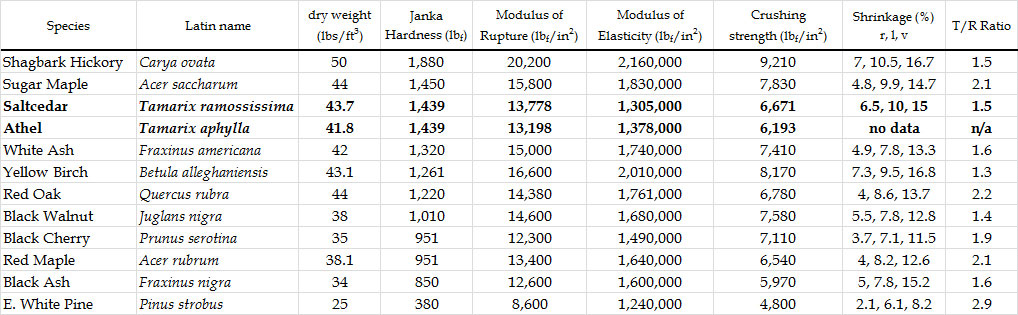
Surprisingly, Saltcedar is similar to many domestic hardwoods in its physical
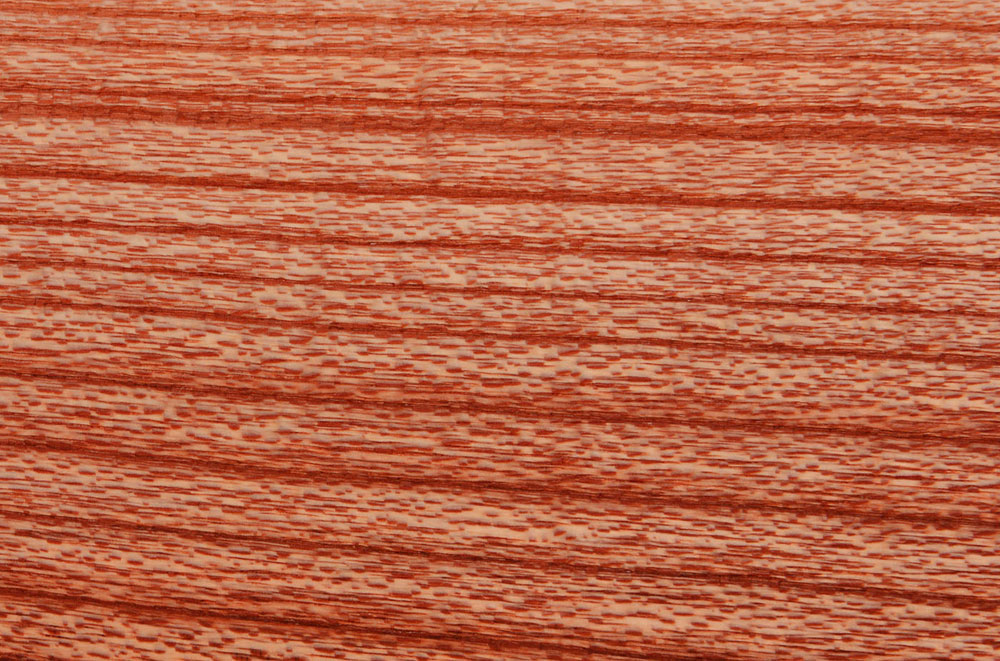
properties (See Table 1 below). The wood is close-grained, fairly hard, heavy, and the wide
heartwood has a rich, pink-red color with distinctive ray-flecks when quarter
sawn - similar to Sycamore (Platanus occidentalis).
Its physical properties are
particularly similar to Sugar (hard) Maple (Acer saccharum) and has a similar density (~43
lbs./ft 3 ) and hardness (Janka hardness 1439 lbs). However, with a low modulus of
elasticity and unusually high shearing strength, it is prone to tear-out even though it is
generally rather straight grained and splits decently. It has a significant blunting effect
on cutting edges but glues, sands, and turns well. It takes on a high polish.
|
Table 1 - Physical properties of selected North American wood species. Both Tamarix species
(Saltcedars) are invasive trees native to
Asia and Africa but have been present in the United States for
over a century. All values are given in English units for clarity.
|
Recently, I was able to acquire several 10-12" diameter logs after a clearing operation
conducted on some federal lands. The agency had set out the logs for the public to take and
use as firewood - a purpose for which it is well suited (except that it must be completely
seasoned, as even slightly green logs smell terrible while burning). What I first noticed was the
color. Beautiful in cross-section, the logs had a bright orange-red coloration similar to Padauk
(Pterocarpus soyauxii). The density was apparent in hefting the logs. Given the rich color and
the weight, I decided to see if I could use the wood as lumber rather than firewood.
Pretty green, it had only been cut a week or two earlier. I decided to split the logs in quarters to
aid in reducing seasoning time. I split them in such a way as to avoid the pretty significant and
obvious branches/knots. Despite the knots it split rather easily, again reminiscent of hard maple.
The grain was pretty straight, though as you would expect it was rather irregular around areas of
branches.
I left it to season for about three months before getting impatient. I wanted to see if that
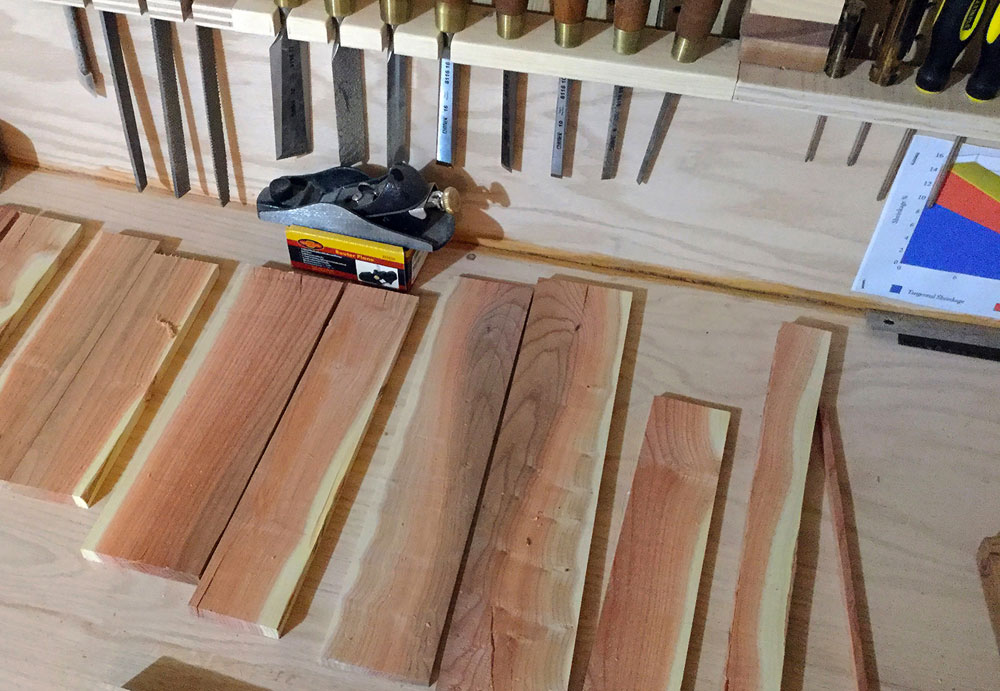
bright red wood was worth it. I built a simple sled jig for the tablesaw and ripped 2-6" wide
boards from the quartered logs, flipping the jig to allow for the wider cuts. I was immediately
pleased with the wood. Though not nearly as bright as the cross-sections had looked, the wood
varied from a subtle pink with very apparent deep red ray flecks to a deep red. Depending on
how it was cut, some pieces had a really nice figure. There had been major checking to the logs
after the trees had been felled and I planned to lose about 1/3 the length of the boards in
removing the end checks. The rough lumber was thickness planed to 1/2-3/4" boards and were
stacked and left to season another two months.
When I returned to the boards I noticed some pretty significant movement and very
differential shrinkage between sapwood and heartwood. Clearly, I had rushed the seasoning. I
re-flattened the boards and left them for another month. When I again returned to the project,
there had been no further apparent movement and the boards were all still flat and square.
I squared the edges, ripped off the end checks, and jointed boards in pairs to give
finished sized boards of approximately 10-12" x 5-6" x 3/8".
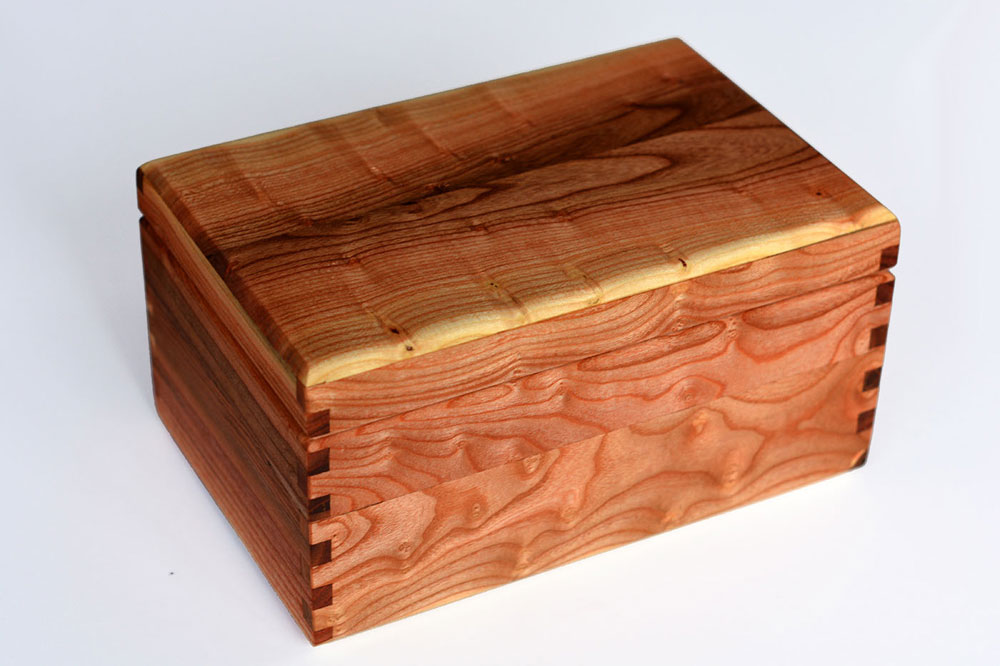
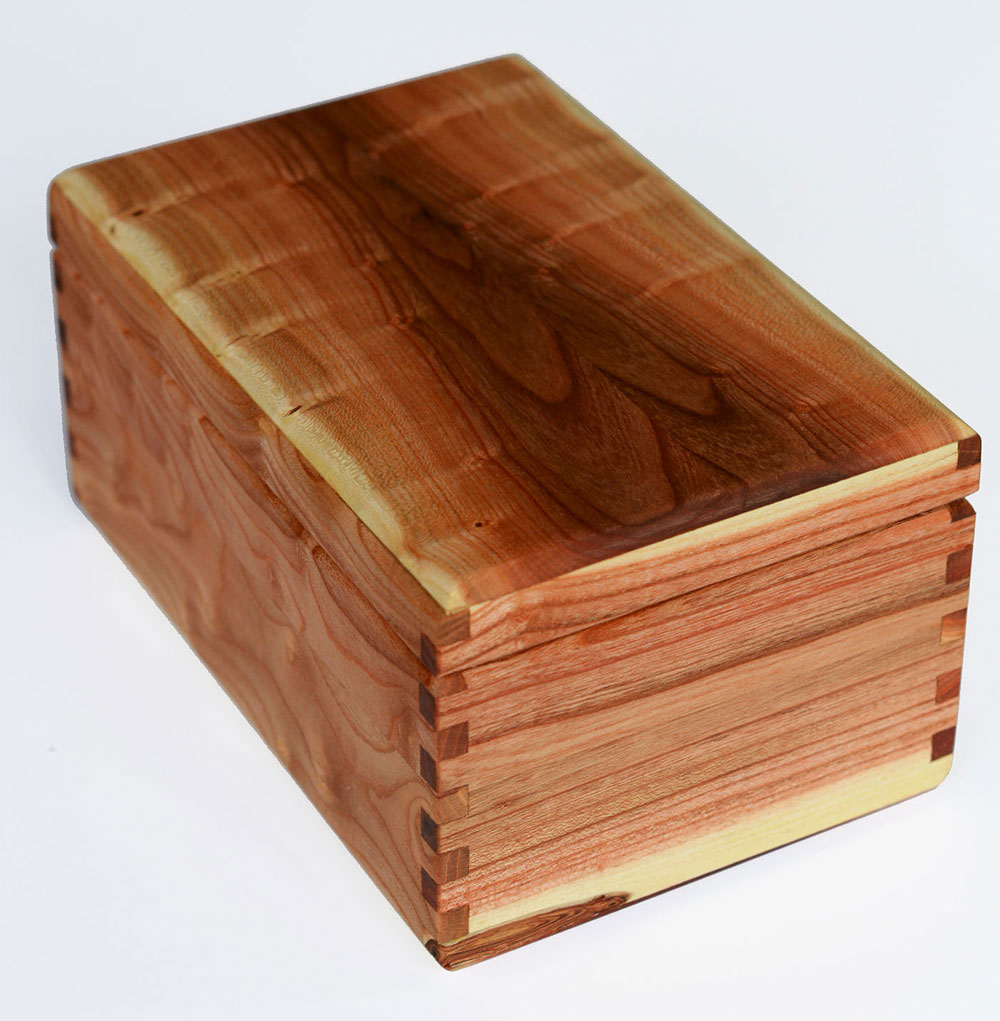
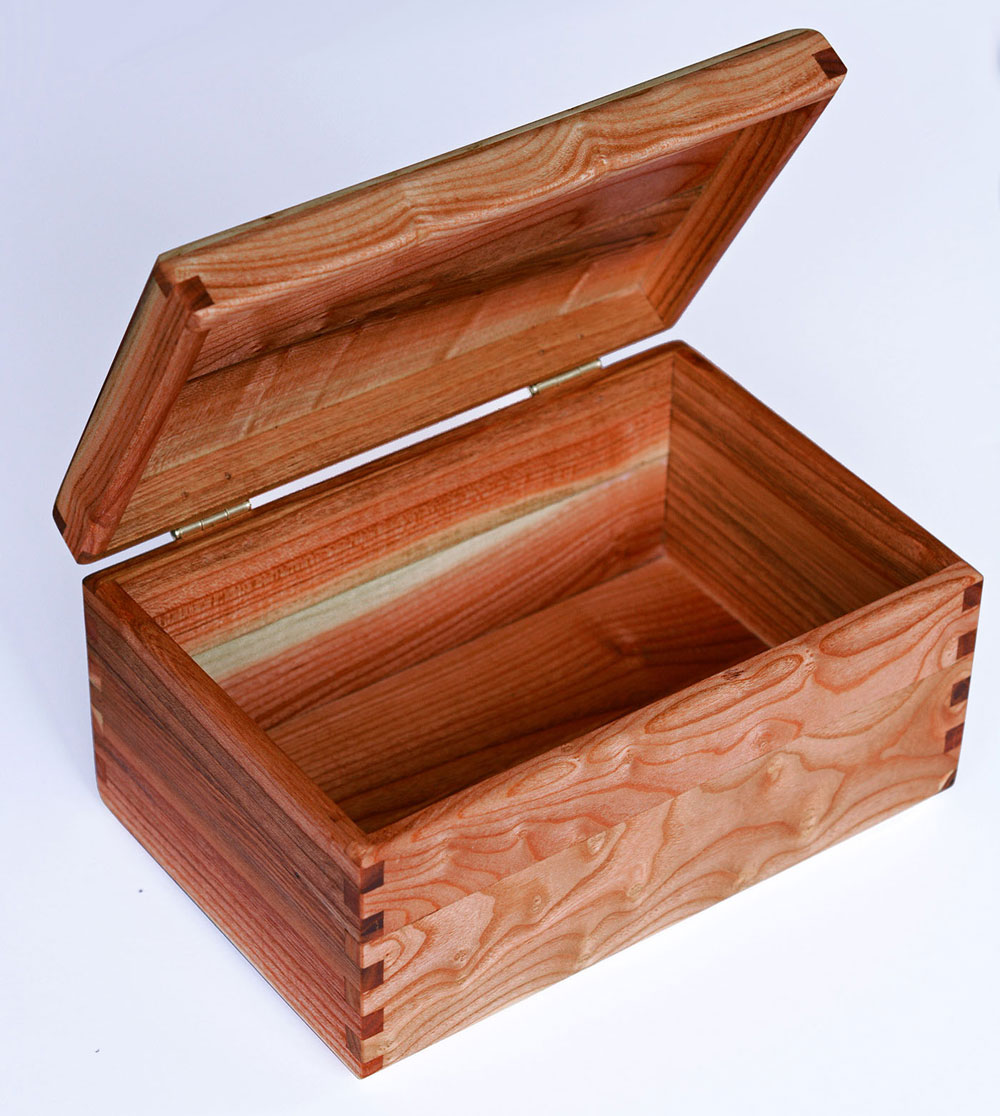
Given the small sized boards and the beautiful color and great figure on several pieces, I
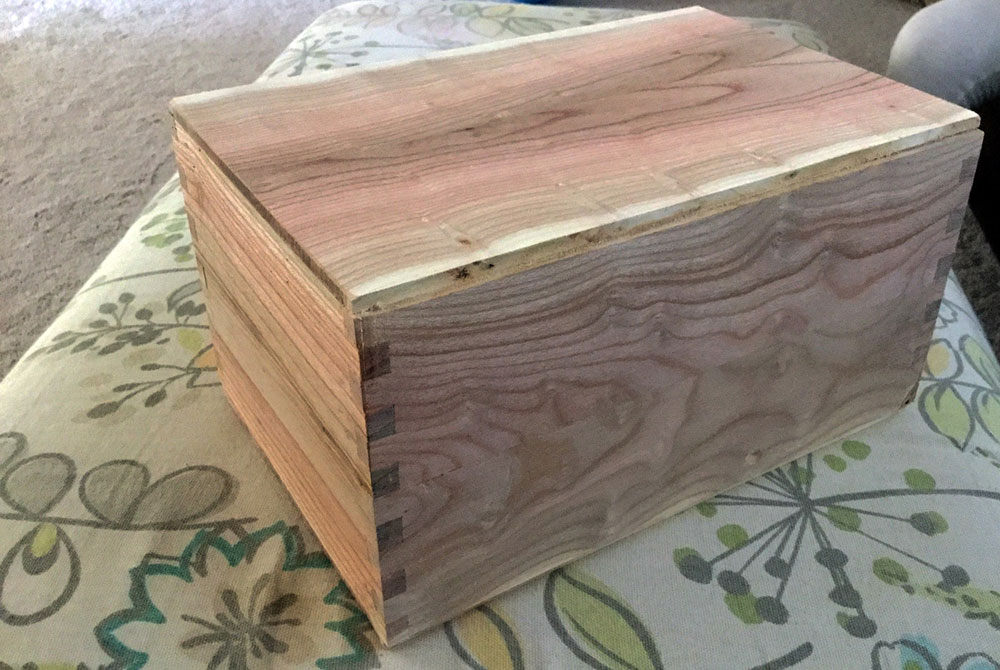
decided to build a decorative box with the wood. Using a simple tablesaw sled jig, I joined the
box with 3/8" finger (box) joints on the sides and rabbeted the edges of the top and bottom.
A little wood glue, a few clamps, and time left me with a saltcedar cube. Using a
Japanese Ryoba Saw
, I cut the finger joints flush. I rounded over all the edges with a rasp and
smoothed all surfaces with sandpaper, working progressively up from 60 to 400 grit.
Using
blue shop tape
I wrapped a line around the box where the top was to be cut off.
Then, using the tablesaw with an 80 tooth blade, I cut off the top. There was a little burning and
the box actually released a puff of smoke when I separated the two pieces. After a little more
sanding around the edges the top fit snug to the bottom. I then taped the box closed across all
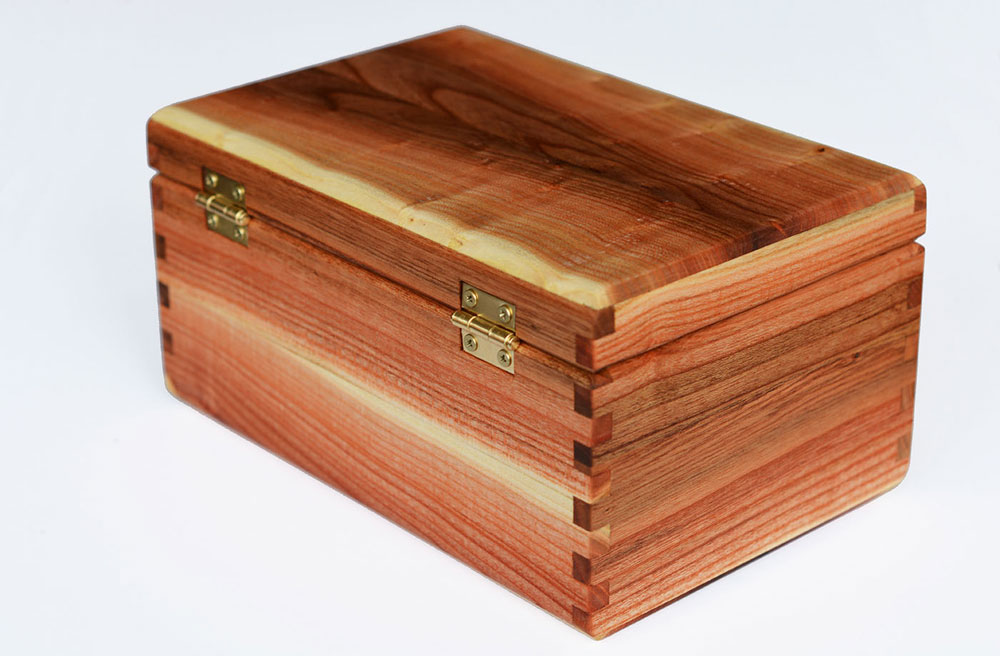
three planes and marked the location of the hinges. Using chisels, I mortised out a space for the
butt hinges and attached them with brass screws. Having set the hinges, I then removed them
in order to apply the finish, which in this case was natural
Watco Danish Oil
applied with a cotton
cloth until the wood no longer absorbed the finish. After the oil was allowed to dry for 24 hours,
periodically wiping off an exuded excess, the hinges were reattached and the box was complete.
Saltcedar is an invasive species which has negatively affected the ecology of the desert
Southwest. However, it has a wood which is hard and strong with a rich red color. If you get a
chance to cut down some saltcedar, do so, and then hold on to the wood. After a proper
seasoning (don't rush it like I did) and a good blade sharpening, you will be rewarded with an
interesting lumber from which you can craft quality wood projects and help to restore the
environment to better growing conditions for more sought after wood.
You can email Dillon with any questions or comments at
browndil@hotmail.com
Return to the
Wood News Online
front page
|