|
It seems there's a silent revival of interest in wooden
handplanes
these days. With a
growing number of books and articles on the subject, the amount of attention to wood-
bodied planes only seems to be growing larger. And why not? Besides their advantage
of being quiet and relatively dust-free tools for working wood, they fairly glide over a
workpiece. Sure, there's a slight learning curve to setting them up, but it seems much
steeper than it really is. Given a properly seated razor-sharp blade, they are capable of
the best shavings you'll ever hope to get. And to top that, they feature the beauty of the
wood from which they're fashioned, which can range over a wide number of species.
Add to that the fact that you can readily craft your own planes using the sandwich style
of construction popularized by James Krenov, with whom Finck studied.
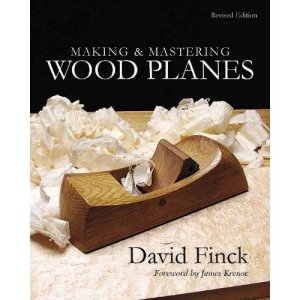
David Finck's book,
Making & Mastering Wood Planes
, now in a revised edition, offers
all the information you'll need to make and successfully use wood-bodied handplanes.
In a methodical way, he sets out every step you'll need to take to bring these beauties
to life and labor in your woodshop.
The first chapter has a dual purpose. It first introduces the relatively small kit of tools
you'll need to build a wooden plane. For the most part, these are
hand tools
— a
block plane
,
dovetail saw
,
chisel
and
file
among them. But some
power tools
, including a
jointer,
bandsaw
and
drill press
, will certainly speed the construction process and at
some points in the process are essential for accuracy.
The second task of this chapter is to spell out how to make the wooden blank that will
form the plane's body. The characteristics of the wood are more important than the
species used. Finck describes what to look for in wood and offers his opinions about
good species and poor ones. Once the wooden blank has been secured, it is sliced into
three sections on the bandsaw, then allowed to "settle" before milling it to final
dimensions. Finck offers good advice on maintaining the bandsaw to keep it at peak
operating condition, valuable information for any woodworker, whether they ever intend
to build a wooden handplane or not.
He adds a discussion of how and where to acquire plane blades, including making your
own, though the wide range of
high-quality blades and chipbreakers available from Ron
Hock
will suit nearly every size and type of plane.
Chapter 2 is a brief discussion of how to tune and use some of the hand tools you'll
need during the construction phase. Whether or not you intend to build a wooden
plane, Finck's presentation on
combination squares
,
straightedges
,
block planes
and
spokeshaves
is at once fundamental and useful.
Recognizing that no plane will function well unless the blade is sharp, Finck devotes
Chapter 3 to sharpening techniques. This discussion, too, is basic and valuable for all
hand tool woodworkers.
The preliminaries now out of the way, Chapter 4 offers a major discussion of how to go
about building a
Krenov-style plane
. In a careful, step-by-step exposition, Finck
describes in high detail everything you'll need to do to build a beautiful and accurate
plane of whatever size you choose.
Chapter 5 presents an important discussion on effective techniques for planing.
Included is attention to edge planing, flattening and truing surfaces, squaring end grain
and finishing polished surfaces. Again, this information will be valuable to any
handplane user, not merely those using wooden planes.
Chapter 6 describes aids for planing, including shooting boards of varying types, bench
hooks and measuring sticks. He then turns his attention to special situations such as
planing large boards, eliminating wobble in boxes and planing curved surfaces.
The final chapter treats the techniques for setting up and using a scraper, again, useful
advice for any woodworker. It concludes with information about how to build a wooden
scraper plane.
As the preceding shows, Finck's book covers a lot of ground, much of it useful to any
hand tool woodworker. His careful, methodical discussion lays out everything you'll
need to know and do to build and use your own wooden handplanes. Having built
several wooden planes myself, I can state with confidence that any serious woodworker
can follow Finck's lead and convert a block of wood—even a solid piece of
firewood—into a handsome and well-functioning handplane. For myself, I'm planning to
build more wooden planes, which are gradually displacing the metal-bodied planes in
my shop. If you have the desire to do the same, you can start nowhere better than by
acquiring and devouring this valuable book.
Find out more and purchase
Making & Mastering Wood Planes
by David Finck
J. Norman Reid is a woodworker, writer, and woodworking instructor living in the Blue Ridge Mountains with his wife, a woodshop full of power and hand tools and four cats who think they are cabinetmaker's assistants. He is the author of
Choosing and Using Handplanes
.
He can be reached by email at
nreid@fcc.net
.
Return to Wood News Online
|