|
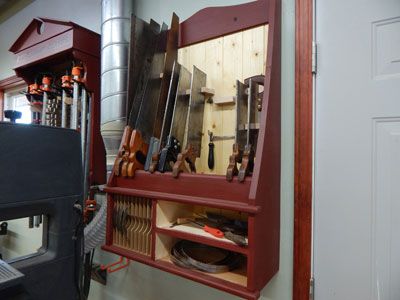
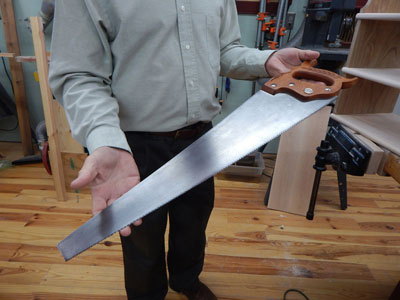 I just finished up a saw till so I can properly store my handsaws off the bench and the floor. As I rounded up saws from around the shop, I opened a box and found a crusty Disston 10 tpi crosscut saw from the 1960's. It's nothing special--the chrome medallion dates it after 1955 when Disston was sold to HK Porter. The handle has the classic wheat pattern chip carving but a very "machine-made" look-and-feel with chipped and peeling finish. The sawplate wears a thick layer of surface rust and has a slight bow along the length. Nothing special—except this was Dad's saw and it's the saw that he taught me to cut with 50 years ago. As I look at all the condition issues of this saw I realize I am looking at the results of my own care and use of my tools. The phrase "Rode hard and put away wet" kind of captures the situation.
Remember your first lesson in sawing? "Hold the saw like this, now pull back to start the cut and keep the tooth line moving straight." Then as you start to pick up speed you get a bit off sideways and—wang!!!—the saw binds and you discover the flexibility of spring steel. This old Disston suffered many binds and bends, too many times I laid it on the bench where it got bent under scrap wood and other tools. Now it has that long even bow where the steel finally gave in to some overbearing force. As you pull it back through a long cut the bow causes the tip of the blade to flutter like a hummingbird.
Surprisingly the teeth still have some bite. I don't see any broken ones but there are flat spots along the tips of the tooth line. Growing up we didn't have saws for different kinds of material so anything I needed to cut met the Disston—plywood, scrap boards with nails, sheetrock, Masonite, coated building boards. I remember building forts and clubhouses and go-carts from a wide assortment of scraps. The saw would get set down any old place with no consideration for keeping the teeth sharp. It can still push through wood but it takes some effort.
The rust came from 50 years of exposure. Dad had a pegboard tool board in the shop and the saw had a place to hang on a hook on the upper left. I also remember that most of the time I left the saw out on the project. "Put the tools away" was one of those life lessons that I didn't quite absorb. Left on a damp concrete floor in the basement, left outside on the building project, caught in the rain, maybe wiped off with a shop rag. Eventually the saw ended up in a plastic storage bin in a musty shop building in the humidity of the Deep South. Now the plate has that uniform brown coating of rust and gunk.
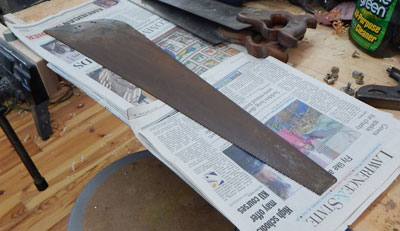 Dad taught me to saw and to love woodworking, but I have to say it seems he slipped up on the care and maintenance side of things. While he told me many time to pick up the tools, he never taught me how to sharpen a saw or how to clean up the tools. Would I have taken better care of the saw if I had had to sharpen it a couple of times? After 50 years the chickens are coming home to roost. It's high time to address all the effects of my neglect.
There are lots of great resources out there on how to restore and sharpen handsaws. I found out it doesn't take a degree in saw doctoring or fancy jigs or tools. I think part of my procrastination on saw care was the excuse that saw work was too complicated. After my wife denied my request for a special saw vise before I started, I learned you can do this with what you have on hand. Just do it! Here's a quick synopsis of what I had to do with Dad's Disston.
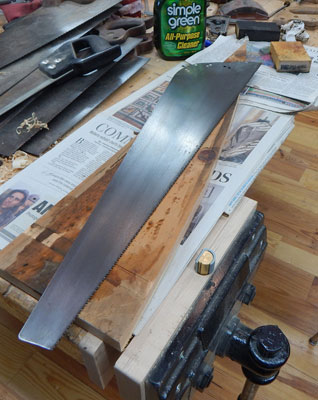
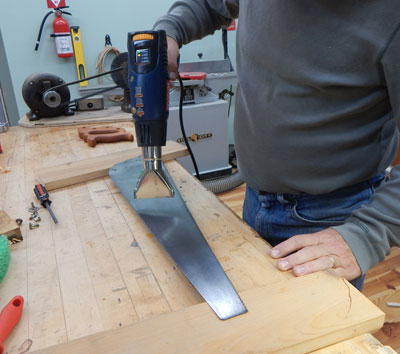
First I disassembled the saw and cleaned the sawplate. I like the Simple Green cleaner approach using flex sponges up to 320 grit. No nasty odor and less toxic mess compared to mineral spirits. The saw plate actually had very little pitting and came up to a nice shine with relatively little effort. Dealing with the bow in the sawplate was a little more involved. Since I had a bow, not a kink, I opted for the low heat option using a heat gun.
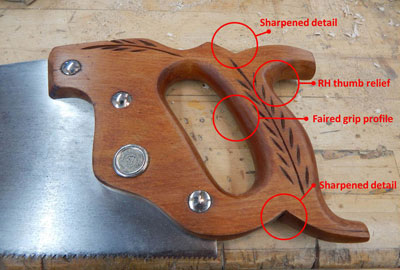
 I gave some hard thought to the handle. There is a lot of value in preserving "patina" and things like paint spots that bear witness to a lifetime of hard work. That would argue for simply cleaning and maybe adding a coat of wax or BLO. However I want this saw to go back in my user rotation and at this point in my journey I have come to appreciate the refinement of hand-shaped handles. In the 1960's the mass-produced saw handle had some of the elements of the classics—the wheat pattern for example—but the overall shape was clearly pattern cut in one pass. The outline lacked any sharp corner details like the notch at the heel. The horns on the mass-produced handles also tend to be bulky to minimize the chance of damage in machine production. The actual grip had some form of rounding but also had a very noticeable angle between the side and the round. When you grip a great saw it fits your hand and you don't feel bumps and angles. I gave in and got out the rasps and sandpaper to refine the handle for a better grip.
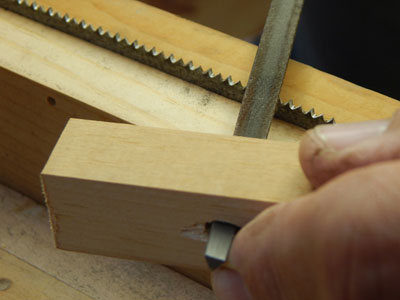
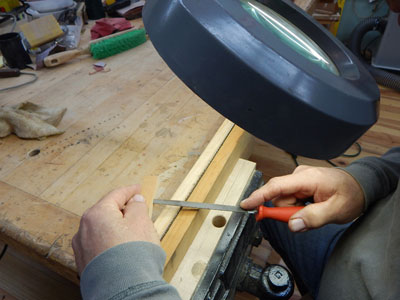
 Finally, the real business end of a saw, sharpening the teeth. I set up a simple clamp in the vise using two scrap boards. The one special purpose tool that I found helpful is a lighted magnifier. 10 tpi means the sharpened faces of each tooth are pretty small and the magnifier helps see the points and edges better. The Disston didn't need jointing or retoothing or setting. After 20 minutes of simple filing the saw has a new edge. No more difficult than sharpening a chainsaw.
 So, after a modest amount of effort I have a crisp crosscut saw ready to go. I have a new appreciation of the effort to sharpen it and will no doubt be more careful about where it lays between cuts. I abhor rust now and promise to always wipe my tools down with wax or oil. I won't just toss this saw in the back of the pickup with the lumber. I suspect that whenever someone else picks up this saw I will cringe inwardly and wonder if they know how to care for tools. Then I will reflect on how Dad must have felt when he handed me his saw and said "Let me show you how to use a saw." Hey Dad, I finally put your tools away.
Bob Rummer works in Research at the University of Kansas and looks forward to getting into his woodshop full-time. He can be reached directly via email at
rummersohne@gmail.com
.
|